01
The scale is off
California, 1933. The Swiss astronomer Fritz Zwicky is studying a cluster of galaxies far out in space and works out how fast the galaxies in it are moving. The number makes no sense: they are way too fast, and the whole cluster should have flown apart long ago. Something is holding it together, something you can’t see. Zwicky writes down his suspicion, in German, for a Swiss journal. And he calls it: dark matter.
But how do you weigh a galaxy in the first place? It doesn’t exactly fit on a scale. What you can do is watch how fast something moves around it. The more mass, the stronger the pull, and the faster something can orbit without flying off. You know this from our solar system: the Earth races around the Sun at about 30 kilometres per second, Neptune, way out there, at only a little over five. The further out you are, the slower you orbit.
That is exactly how Zwicky did the maths. The galaxies in his cluster were zipping around at about 1,000 kilometres per second. For that, the cluster would need hundreds of times more mass than everything shining in it. His number was too high, because distances in space weren’t properly known back then. But the puzzle remained. Only hardly anyone listened, and that was partly Zwicky’s own fault: he called his colleagues spherical bastards, because they were bastards no matter which side you looked at them from.
Almost 40 years later, another researcher takes a fresh look: Vera Rubin. In 1965 she became the first woman allowed to officially observe at the Palomar Observatory. There was only a men’s room there, so she taped a little paper skirt onto the figure on the door. Together with her colleague Kent Ford, she measures how fast the Andromeda Galaxy rotates, from the centre all the way to the edge.
They expected the same thing as in the solar system: further out, things get slower. But the curve doesn’t drop. It stays up, and all the way at the edge everything orbits almost as fast as further in. By 1980 Rubin has measured 21 galaxies, and it is the same everywhere. With what we can see, these stars should have flown off long ago. Unless every galaxy sits inside a huge, invisible shell of mass, much bigger than the galaxy itself. Rubin did not discover dark matter with this, but she delivered the strongest early evidence for it.
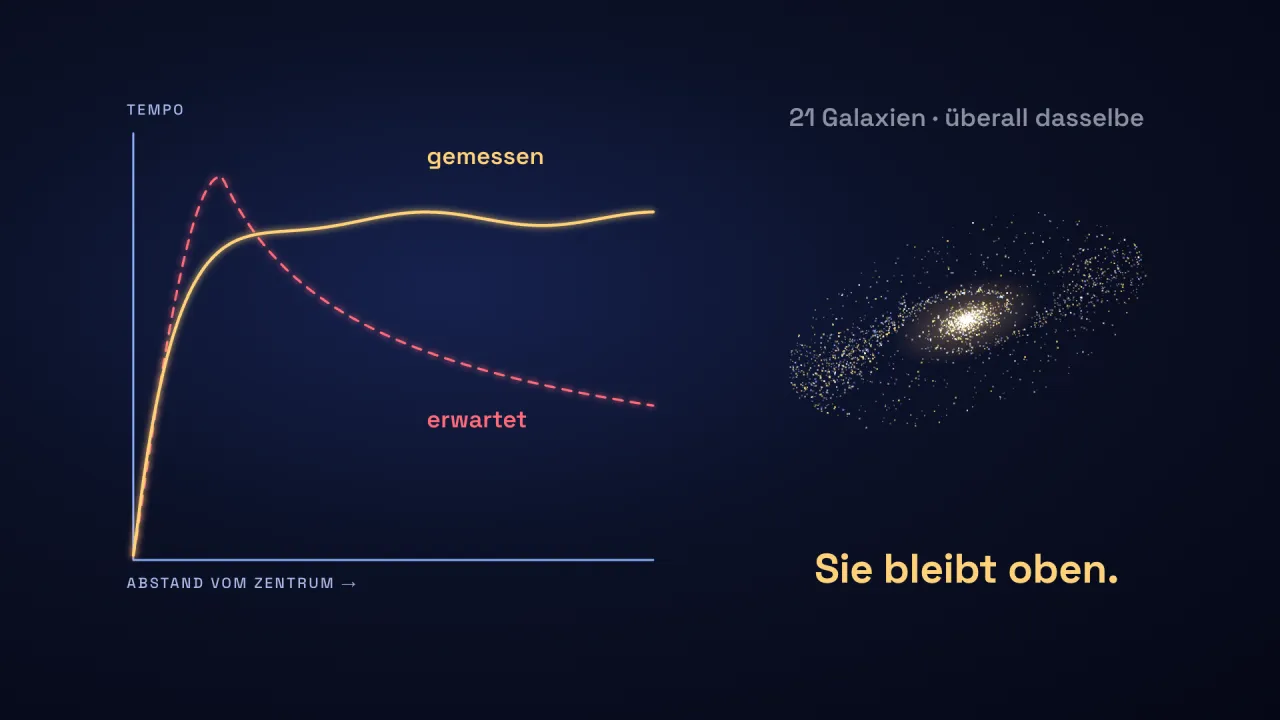
How fast something orbits tells you how much mass is holding on to it. Galaxies orbit as if there is far more mass than we can see.
In the video from 1:1502
Clues without a culprit
Fast stars are only the first clue. The second one is the Bastiverse logo: mass bends light, as we saw in episode 3. Light from distant galaxies gets distorted on its way to us, sometimes even into a ring. From that distortion you can calculate how much mass lies in between, even if you can’t see anything there. And the person who proposed that, in 1937, was none other than Fritz Zwicky.
That leads to maybe the strongest evidence of all: two galaxy clusters that crashed into each other at thousands of kilometres per second. Their light travelled for a little over three billion years. Most of the normal matter in clusters like these is in hot gas. This gas slammed together and got slowed down, while the galaxies themselves simply flew past each other. Then researchers used the distortion of light to check where most of the mass is. With the gas? No. Way off to the side, with the galaxies. So something flew right through the collision as if nothing had happened.
The third clue is the oldest: the afterglow of the Big Bang, the snow on the TV from episode 5. In the early universe there were only tiny differences, about one part in a hundred thousand. All the galaxies grew from those. With normal matter alone, that would have taken far too long. Dark matter, on the other hand, could clump together early. It was the scaffolding that normal matter fell into. Without it there would probably be no galaxies, no stars and nobody around to wonder about it.
Add it all up, and you get about five times as much dark matter as normal matter.
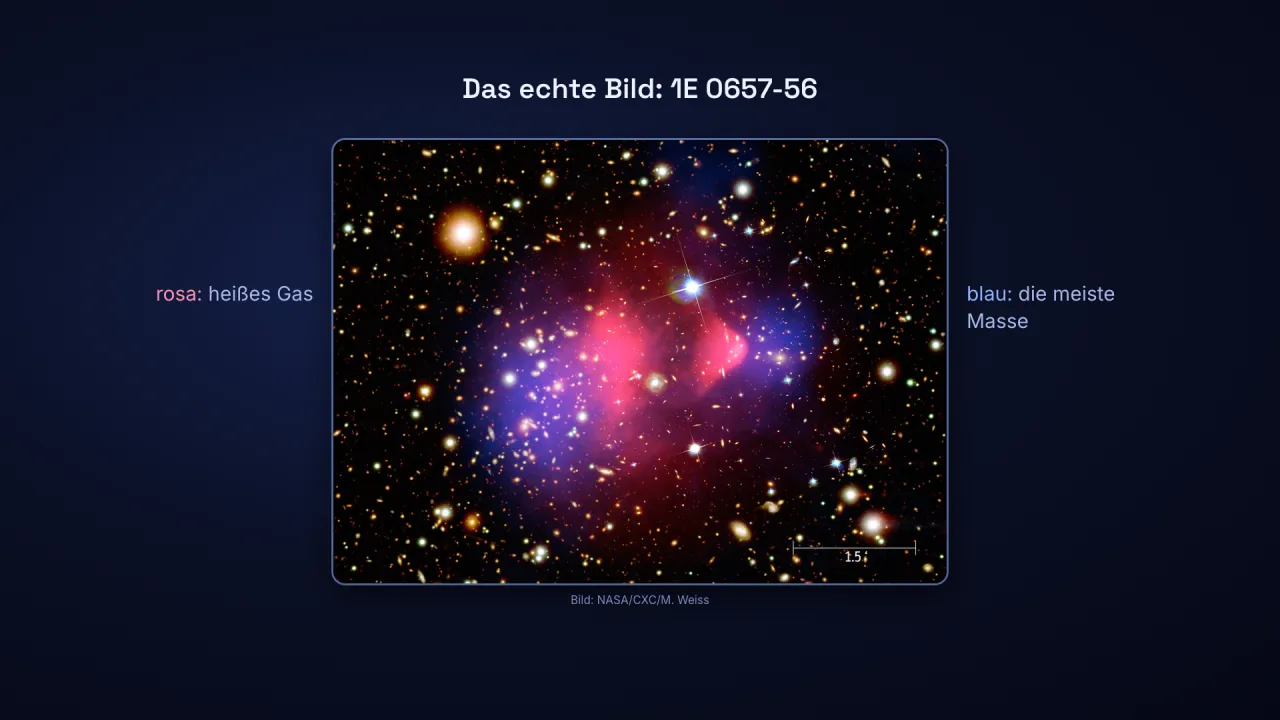
Fast stars, bent light, colliding clusters and the afterglow of the Big Bang all tell the same story: about five times as much dark matter as normal matter.
In the video from 3:1103
What could it be?
First things first: dark is actually the wrong word. A dark cloud swallows light. Dark matter doesn’t. It doesn’t shine, it doesn’t swallow anything, it doesn’t reflect anything. It isn’t dark. It is transparent.
First suspect: perfectly normal things that are just hard to see, like burned-out stars, lonely planets and black holes. People searched for those for years. From everything we know, that is not enough. Second suspect: neutrinos. They exist, and they fly through almost everything. But they are too light and too fast; they can’t build a scaffolding. That leaves something nobody has ever seen: a new particle.
There are two favourites. The first: heavy particles that have almost nothing to do with anything else. They are called WIMPs, short for weakly interacting massive particles. The second: extremely light particles called axions. The physicist Frank Wilczek named them after a laundry detergent, because they would clean up a problem in physics. So the hottest candidates in modern physics are a wimp and a laundry detergent.
And then there is a completely different possibility: maybe there is nothing invisible there at all, and gravity simply works differently over long distances. That is not a crazy idea. For individual galaxies it works surprisingly well. But with the colliding clusters and the afterglow, it struggles. That is why most researchers think dark matter is the better explanation. It won’t be proven until somebody catches it.

Dark matter isn’t dark, it is transparent. It is probably a particle nobody has seen yet.
In the video from 4:5504
The hunt
If it is WIMPs, then billions of them are flying through you right now. Every second. You don’t notice a thing. Almost all of them just keep going, through you, through the Earth and out the other side. And here comes the strange part: in the whole volume of the Earth, there is less than a kilogram of it. Dark matter is spread extremely thin. It only counts because space is so unbelievably huge.
That is why researchers look where it is really quiet: in South Dakota, almost one and a half kilometres underground, in an old gold mine. There is a tank there with seven tonnes of liquid xenon. The rock blocks almost all disturbances. If a particle does hit an atomic nucleus, there is a tiny flash. Found so far: not a single particle of dark matter. But by now the detector is so sensitive that it can sense neutrinos from inside the Sun. That is great. And a problem, because they look confusingly similar to light dark matter particles.
In Hamburg they are trying something different. At the DESY research centre, they shine a laser at a wall. On purpose. The idea: in a strong magnetic field, a tiny part of the light could turn into particles like axions. They fly through the wall and turn back into light behind it. The first measurement run was over twenty times more sensitive than all similar experiments before it. But behind the wall, it stayed dark. For now.
And the search is on in space too. The European telescope Euclid is mapping light distortions across a large part of the sky, and the first big maps are expected in 2027. Along the way, Euclid is hunting a second phantom: the universe is expanding faster and faster, and nobody knows exactly why. Whatever is behind it is called dark energy, and it makes up about two-thirds of everything. It probably shares nothing with dark matter except the name. And in Chile a giant new telescope is photographing the entire southern sky. It bears the name of Vera Rubin. She never got the Nobel Prize, but her name is now on the telescope that is following up on her mystery.

Nobody has caught dark matter yet. The search is on deep underground, in the lab and in space.
In the video from 6:4005
How big is all this?
In this episode we have been throwing around galaxies and billions of years. But how big is all this, really? In November 2026 the Voyager 1 space probe reached a special milestone: its radio signal now takes a whole day to reach us, after almost 50 years of flight. Sounds far. In the universe, that is not even out the front door.
So let’s take a drive, from the Earth to the end of everything we can see. That is what the next episode is about.