01
Waves in spacetime
On 14 September 2015, shortly before noon, Marco Drago, a young physicist from Italy, is sitting at his computer in Hanover. An automatic message comes in with two curves, recorded by two facilities in the USA, 3,000 kilometres apart. Both show the same short chirp, like a bird. It is a tremor in spacetime itself.
Space and time together form a fabric, spacetime, and mass bends it. As long as a mass lies still, the dent stays calm. But when heavy things move, for example two stars orbiting each other, they stir up spacetime, like two balls circling in water. Waves run outwards from them at the speed of light. Those are gravitational waves.
When such a wave passes through you, you become a tiny bit taller and narrower, then shorter and wider, and taller and narrower again. Everything around you joins in: the house, the Earth, every ruler. You don’t notice any of it, because the effect is much, much smaller than an atom.
Albert Einstein predicted this in 1916. But he was never sure. Twenty years later he even wrote a paper concluding that gravitational waves don’t exist at all. A referee found a mistake in the calculation. Einstein was rather offended, but he corrected the mistake. And even if they do exist, he thought, they are far too weak ever to be measured.
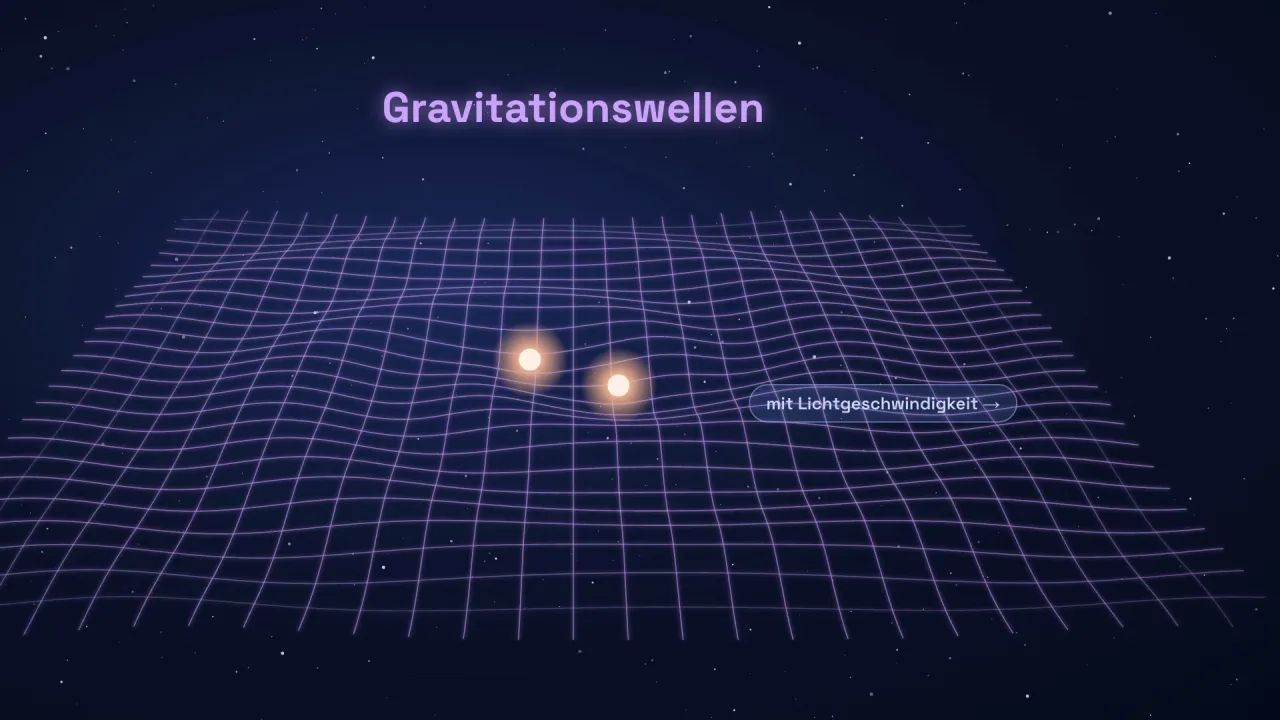
Gravitational waves are a tremor in spacetime itself. Everything they pass through is alternately stretched and squeezed a tiny bit.
In the video from 1:2302
The most sensitive ruler in the world
There is a real problem here: when space stretches, your ruler stretches with it. You can’t measure anything with it. The trick is light. It always travels at the same speed, as we saw in episodes 1 and 4. Hang two mirrors up freely and send light back and forth between them, and this holds: if the path gets longer, the light takes longer.
That is exactly how LIGO works, the facility that measured the chirp in 2015. A laser is split into two beams. They run through two tubes, each four kilometres long, at right angles to each other, are reflected by a mirror at the end and meet again. There everything is set up so that they cancel each other out: crest meets trough, and it stays dark. But when a gravitational wave comes along, one arm gets a little longer and the other shorter. Then the waves no longer match, and light flickers at the output.
To make this sensitive enough, the light travels back and forth around 300 times in each arm, which adds up to 1,200 kilometres. The mirrors are 40-kilogram blocks of glass, suspended from fine glass fibres. The tubes are almost empty of air, one of the largest vacuums in the world. And the lasers inside come from Hanover.
With the first signal, the arms changed by around a thousandth of an atomic nucleus. That is like measuring the distance to the nearest star, more than 40 trillion kilometres, to within the width of a hair.
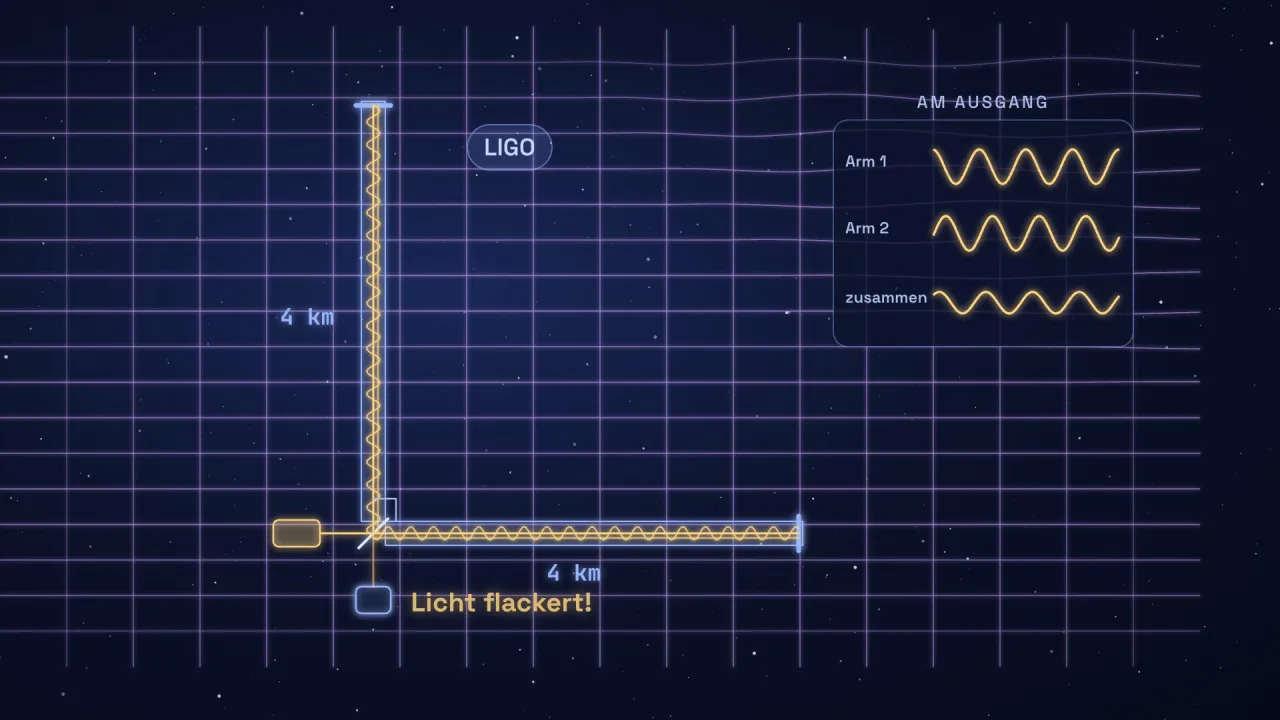
The measuring is done with light, because light always travels at the same speed. If an arm gets longer, the light takes longer.
In the video from 2:3303
Everything shakes
The hardest part isn’t the measuring at all, it’s everything else. Because everything shakes far more than any gravitational wave: a lorry on the road, loggers in the forest next door, the wind, ocean waves on a coast hundreds of kilometres away.
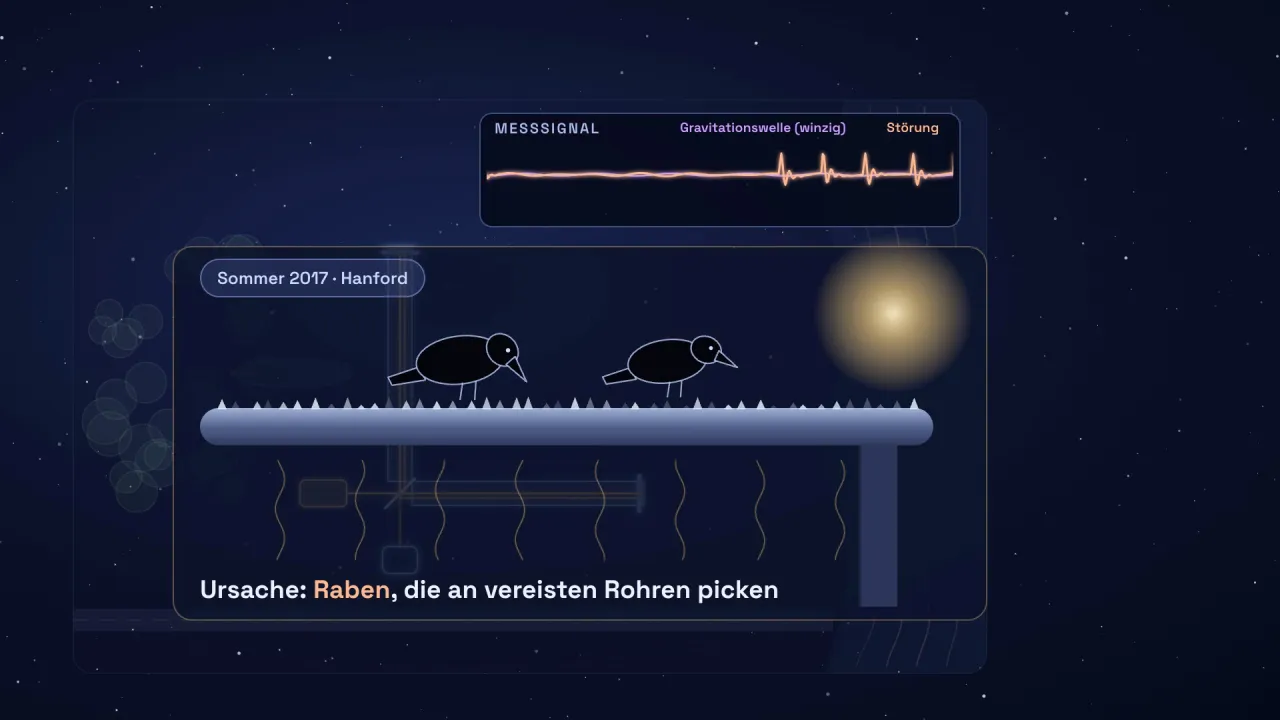
And ravens. In the summer of 2017, disturbances kept turning up at one of the facilities, always on hot afternoons. The cause: ravens pecking at iced-up pipes. They were treating themselves to an ice lolly.
That is why there are two LIGOs. One facility is in the north-west of the USA, in Hanford, the other in the south, in Livingston, with 3,000 kilometres in between. A lorry in Livingston doesn’t shake anything in Hanford. A real gravitational wave, though, arrives at both, at the speed of light, so at most ten milliseconds apart. In 2015 the chirp arrived first in Livingston and seven milliseconds later in Hanford.
And why did Marco Drago first think of a test? Because it had happened before. In 2010 the researchers found a signal that looked perfect. They analysed it for months and had even written a scientific paper. Then a sealed envelope was opened, and inside it said: that was a test. A small handful of people had secretly injected a fake signal to check whether the others would find it. That is why in 2015 everyone looked very carefully, for five months. Only then did the news go around the world.
A real gravitational wave reaches both facilities, a lorry only one. That is why you need two, far apart.
In the video from 4:0604
What we’ve heard since
So what actually happened? Around 1.3 billion years ago, two black holes were orbiting each other, one 36 times as heavy as the Sun, the other 29 times. They came closer and closer, circled faster and faster, at the end at almost half the speed of light, and merged into one. And something was missing: the mass of three Suns, turned into gravitational waves in two tenths of a second. For that moment it was more power than all the stars in the visible universe put together. And yet not a single ray of light, only the tremor.
This wave oscillates as fast as a sound our ears can hear. Made audible, it sounds like a chirp, from low to high, faster and faster. Those are the last orbits of two black holes.
In 2017 this earned the Nobel Prize. One of the laureates was Rainer Weiss, born in Berlin. The idea for LIGO was his. A few weeks earlier the next big signal had arrived, this time from two neutron stars. Their tremor had been on its way for 130 million years. 1.7 seconds later a satellite saw a flash of gamma rays from the same direction. Gamma rays are light too, just with much more energy. After a journey of 130 million years, both arrived almost at the same time: so gravitational waves are just as fast as light. In the afterglow, telescopes saw heavy elements. Some of the gold on Earth was probably made in a collision like this.
Today four facilities listen together: the two in the USA, one in Italy and one deep under a mountain in Japan. By now they have picked up several hundred signals, in the last observing run one every few days on average. Almost always they are black holes, things that send out no light. We would never have seen them with any telescope in the world.
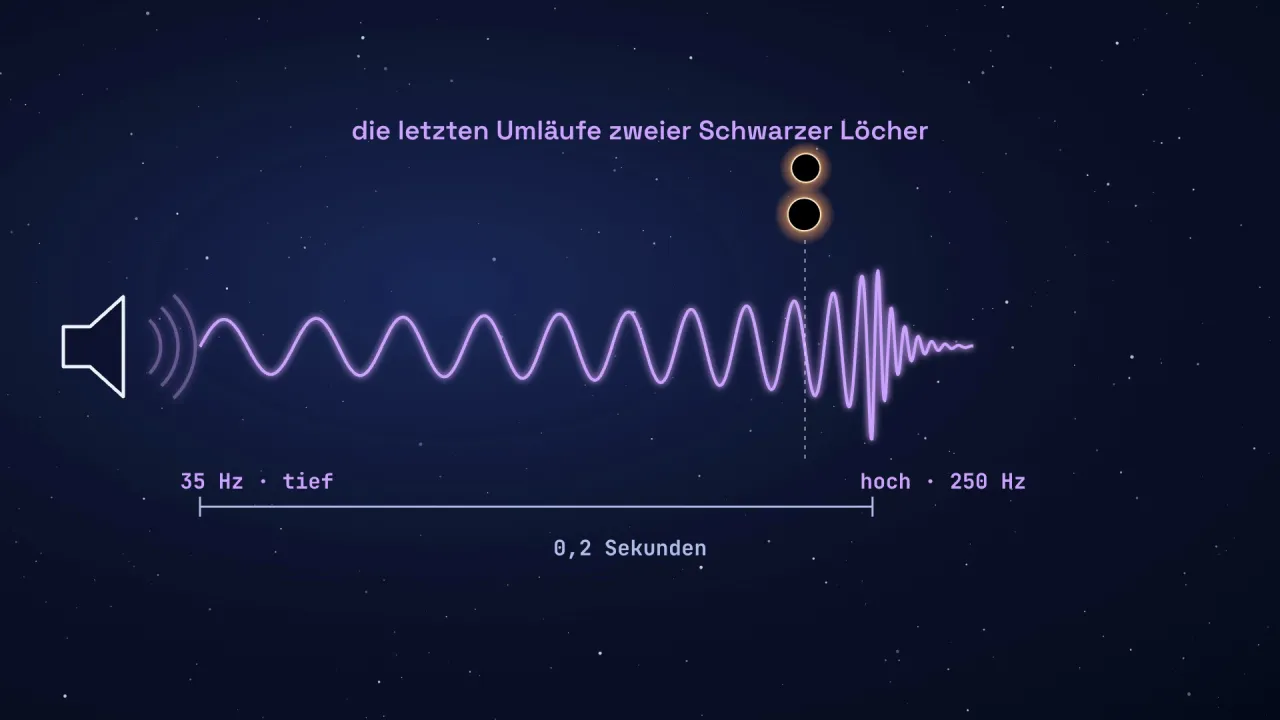
With gravitational waves we hear things that send out no light.
In the video from 5:3305
The next ear
And it goes on. An even more sensitive facility is planned in Europe: the Einstein Telescope, deep underground, with arms more than ten kilometres long. One of the candidate sites is Lusatia in Saxony, in eastern Germany. The decision is expected in 2027.
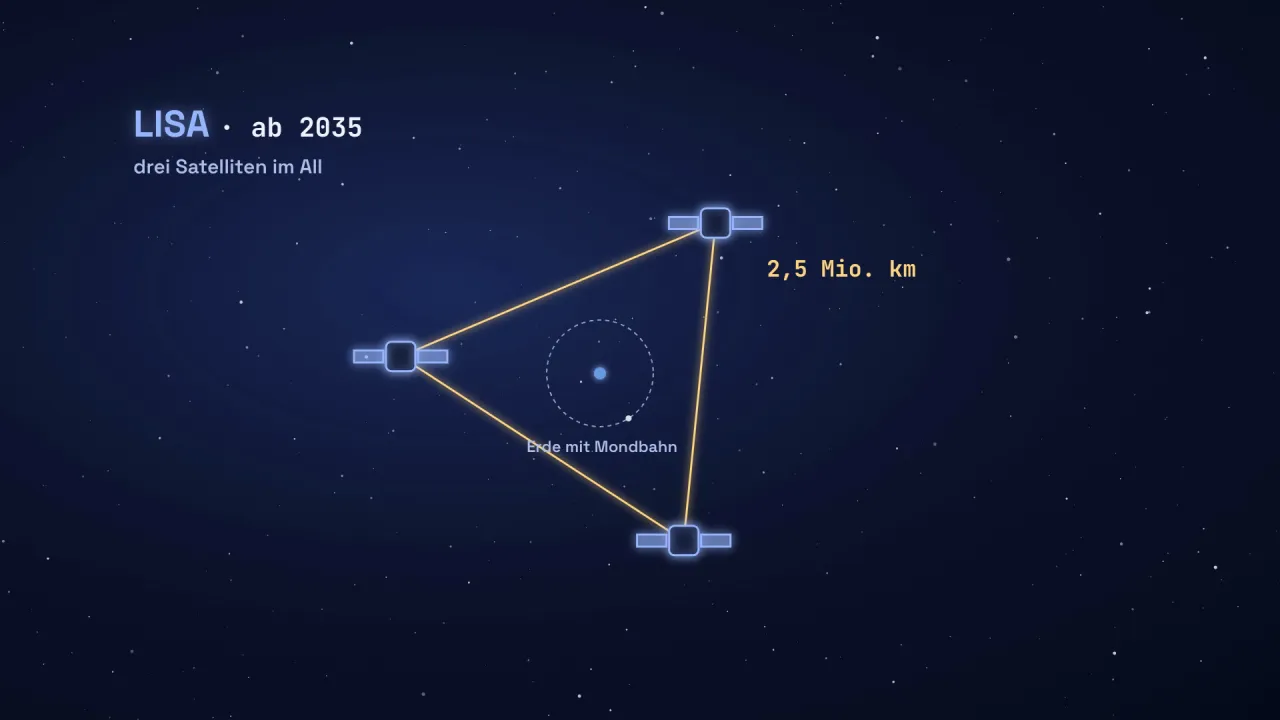
Around 2035 the LISA mission is also due to launch: three satellites in space, two and a half million kilometres apart. A measuring device bigger than the orbit of the Moon.
But out there is something even more mysterious. The stars at the edge of galaxies orbit far too fast; they ought to fly away. Something is holding them in place, something we can’t see. And there is around five times as much of it as of the matter that stars, planets and we are made of. What this dark matter is will be the subject of the next episode.