
01
Two hundred billion tickets
The Milky Way has a hundred to four hundred billion stars, nobody knows exactly. For this series’ calculation we take two hundred billion. Every star is like a lottery ticket: one attempt by nature to have someone, somewhere, ask the question Fermi asked. Two hundred billion lights, and all of them still burning.
In Fermi’s time nobody knew whether other stars even had planets. The first ones weren’t found until the nineties. Today we know of over six thousand. And the area where we are even searching is tiny: nine out of ten known planets lie in a small corner around the Sun. So we’ve barely looked, and there are already planets everywhere. On average, every star probably has at least one.
On top of that, the Milky Way is old, about ten billion years, more likely more. The Sun only joined a little over four and a half billion years ago. In the zone of the galaxy that’s probably best suited for life, by one calculation, three out of four stars are older than the Sun. So we’re not the first ones at the party. We’re late.
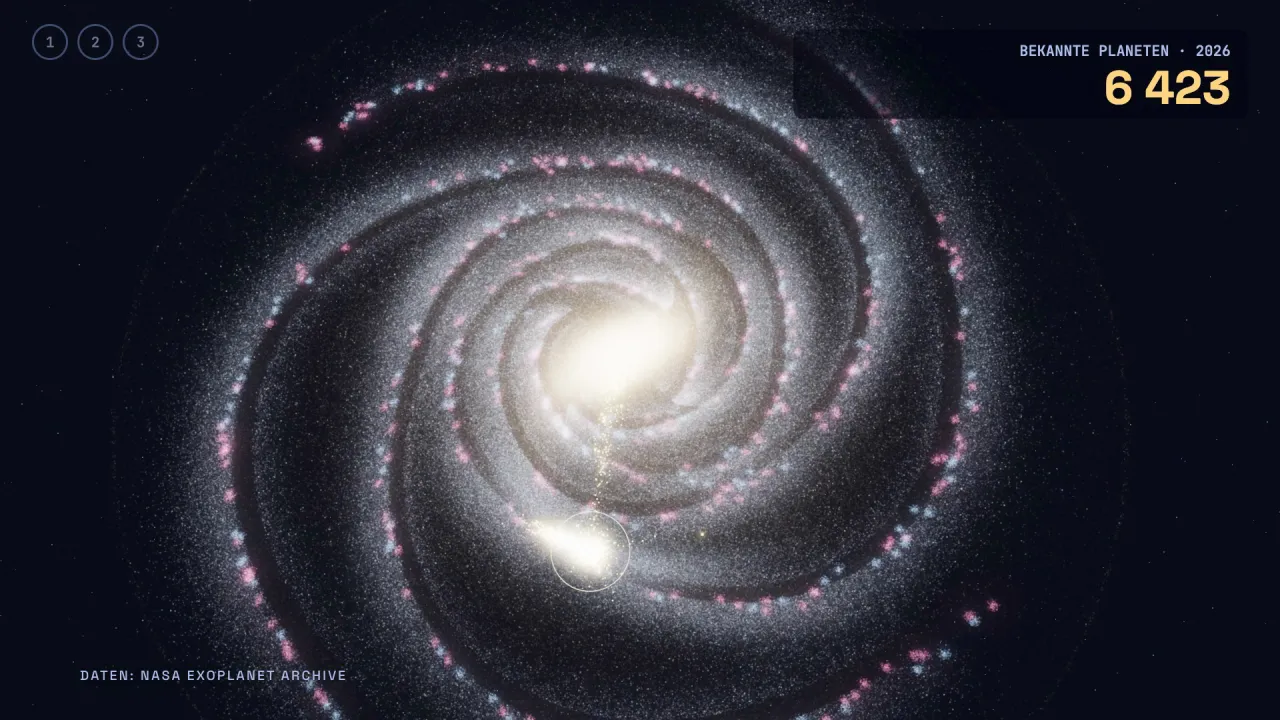
We’re late to the party. And the room is empty.
In the video from 1:4402
One would be enough
So far it sounds like this: there should be many. But the real bombshell doesn’t come from Fermi at all. In 1975 the astrophysicist Michael Hart publishes a paper with this idea: there don’t need to be many. A single civilization is enough. Because anyone who makes it to the next star can go on from there, to the one after that, and so on.
Imagine the ten billion years of the Milky Way as one single day. A civilization sets off with ships that manage one percent of the speed of light. We can’t do that yet, but no law of nature forbids it either. Straight across the galaxy is a hundred thousand light-years, which takes ten million years. On our clock: a minute and a half. If we give the ships a break of nine thousand years every ten light-years to land, set up and build new ships, everything takes ten times as long. Fifteen minutes, in a day that has twenty-four hours.
It can go even slower. In 2019 researchers simulated how settlement spreads, even with sluggish probes. Because the stars are moving too, new targets keep coming into range. Their result: settlement spreads across the galaxy in at most about three hundred million years. On our clock, that’s not even forty-five minutes.
And nobody even has to go along. Probes that build copies of themselves at their destination will do. One becomes two, two become four. After just thirty-eight doublings there would be more probes than the Milky Way has stars in our calculation.
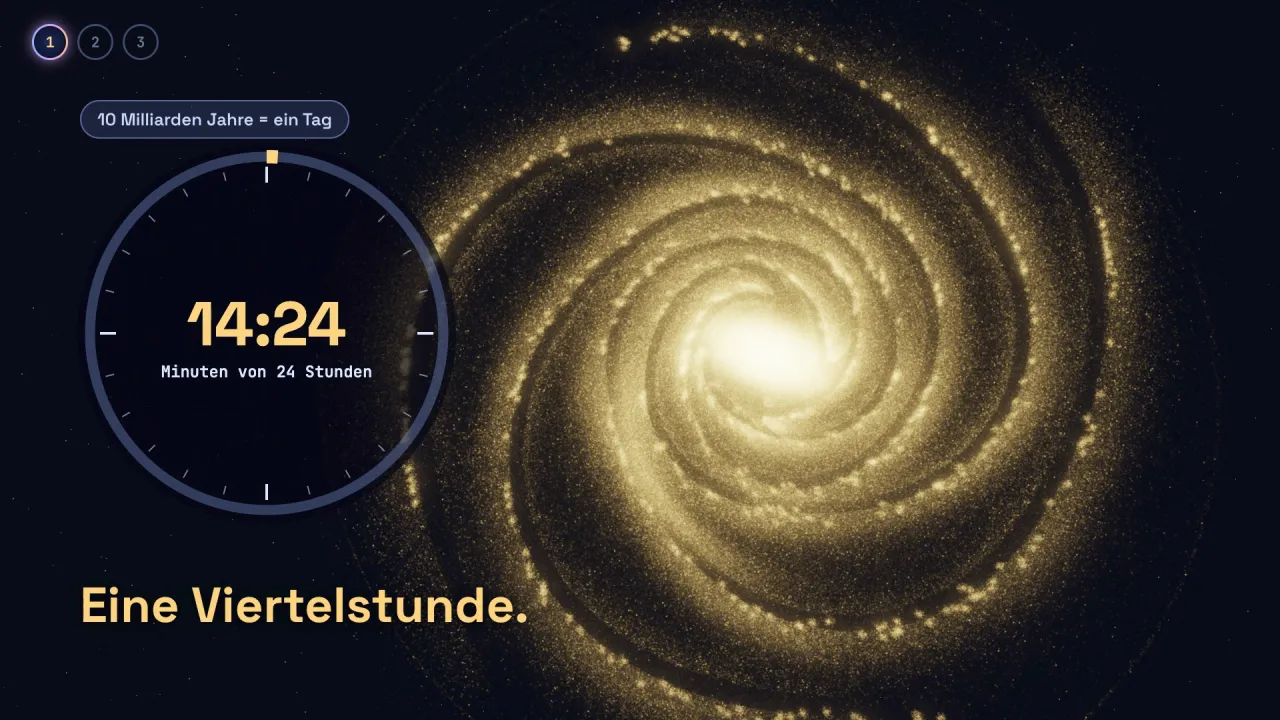
It’s not enough for most of them to stay home. All of them would have to stay home, for ten billion years, without a single exception.
In the video from 3:0703
The great silence
And what do we see? Nothing. No alien probe in the solar system, no ruin on the Moon, no signal that has held up to scrutiny. And UFOs? Despite plenty of videos and reports, not a single sighting has so far been confirmed as a visit from aliens.
Now you could say: but we’ve barely looked. And that’s actually true. Sofia Sheikh of the SETI Institute puts it like this: if everything you’d need to search were as big as all of Earth’s oceans, then so far we’ve covered a small swimming pool.
For radio signals, that’s a good argument. But against Michael Hart’s idea it only helps halfway. Because he isn’t asking whether we hear anyone. He’s asking why nobody is standing here. Why the night sky is dark, we were able to answer in the previous episode. Why it’s so quiet, not yet.
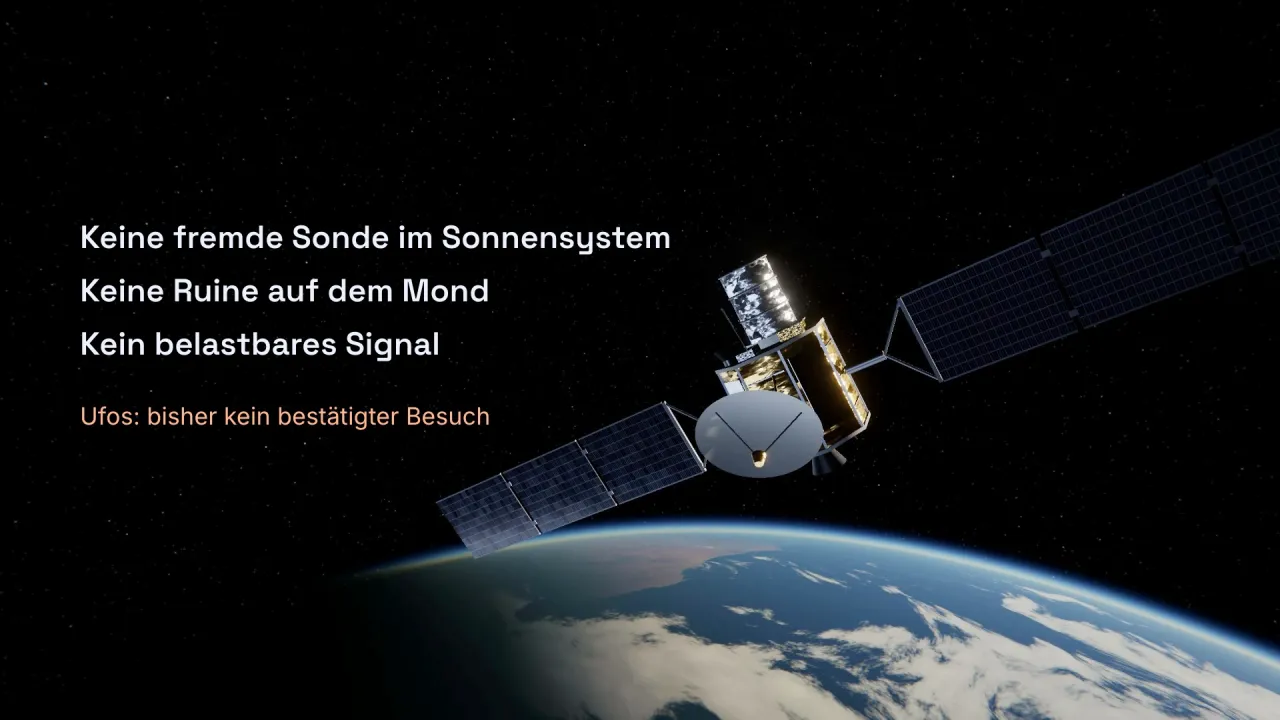
Hart isn’t asking whether we hear anyone. He’s asking why nobody is standing here.
In the video from 5:0404
What Fermi really meant
The scene is famous: summer 1950, Los Alamos. Four physicists are walking to lunch, and one of them mentions a cartoon in The New Yorker in which little green men carry New York’s missing public trash cans into their spaceship. Later, at the table, Enrico Fermi asks out of nowhere: where is everybody? The others laugh, and everyone knows right away who he means.
Today the whole thing is called the Fermi paradox. Except that Fermi never published anything about it. The term doesn’t show up until 1977, by which time Fermi had been dead for twenty-three years. We only know the scene at all thanks to Eric Jones: in 1984 he wrote to the three surviving men from the lunch table. Their memories differ, and the famous napkin Fermi supposedly did his maths on doesn’t appear in any of them.
So what was it really about? On the way to lunch the physicists were debating whether you can fly faster than light. Fermi asked Edward Teller how likely that was in the next ten years. Teller said: one in a million. Fermi said: more like ten percent. And after his question, as Herbert York recalls, if vaguely, Fermi named three possible reasons why nobody is here: flights like that are impossible. Or they’re never worth it. Or civilizations don’t last long enough. So Fermi never claimed that aliens don’t exist.
That conclusion came later, from Michael Hart: they’re not here, so they don’t exist. And it had consequences. In 1981 a US senator cut NASA’s funding for the search for aliens and argued exactly that way. One question at lunch, and thirty years later a space agency is short on budget.
But Hart’s calculation only holds if every single step is right. If nobody is here, three doors remain. Door one: nobody’s there, life is much rarer than we think. Door two: nobody gets through, the journey is too hard, or civilizations don’t last long enough. Door three: nobody’s answering, they’re there, but they stay silent, or we don’t recognize them. Behind each door are some pretty unpleasant possibilities. The series goes through all three.

Fermi never claimed that aliens don’t exist. All he did was ask.
In the video from 6:0005
A formula on the board
Before the first door opens, we need a tool. In 1961 a young radio astronomer invites people to a small meeting. As the agenda, he writes a formula on the board. It’s supposed to say how many civilizations there are in the Milky Way.
It became the most famous equation of the whole search. And it proves nothing at all. That’s exactly what the next episode is about.
In the video from 7:59