01
Seven symbols
Summer of 1961, Green Bank, deep in the woods of West Virginia. A young radio astronomer’s phone rings: Frank Drake, thirty-one years old. A year earlier he became the first person to point a big telescope at other stars and listen for signals: two stars, a hundred and fifty hours, nothing. On the line is a man from the Academy of Sciences. He wants everyone who’s seriously working on the search for aliens in one room. The two of them count and come up with ten people. The entire field fits in a minibus.
Drake is asked to write the agenda. What would you actually need to know to find life in space? How many stars are born, how many have planets, on how many does life appear? Then he notices: this isn’t a list at all. Multiply the items together and you get a number, the number of civilizations in the Milky Way. On 1 November 1961 he writes the whole agenda on the board as a single line.
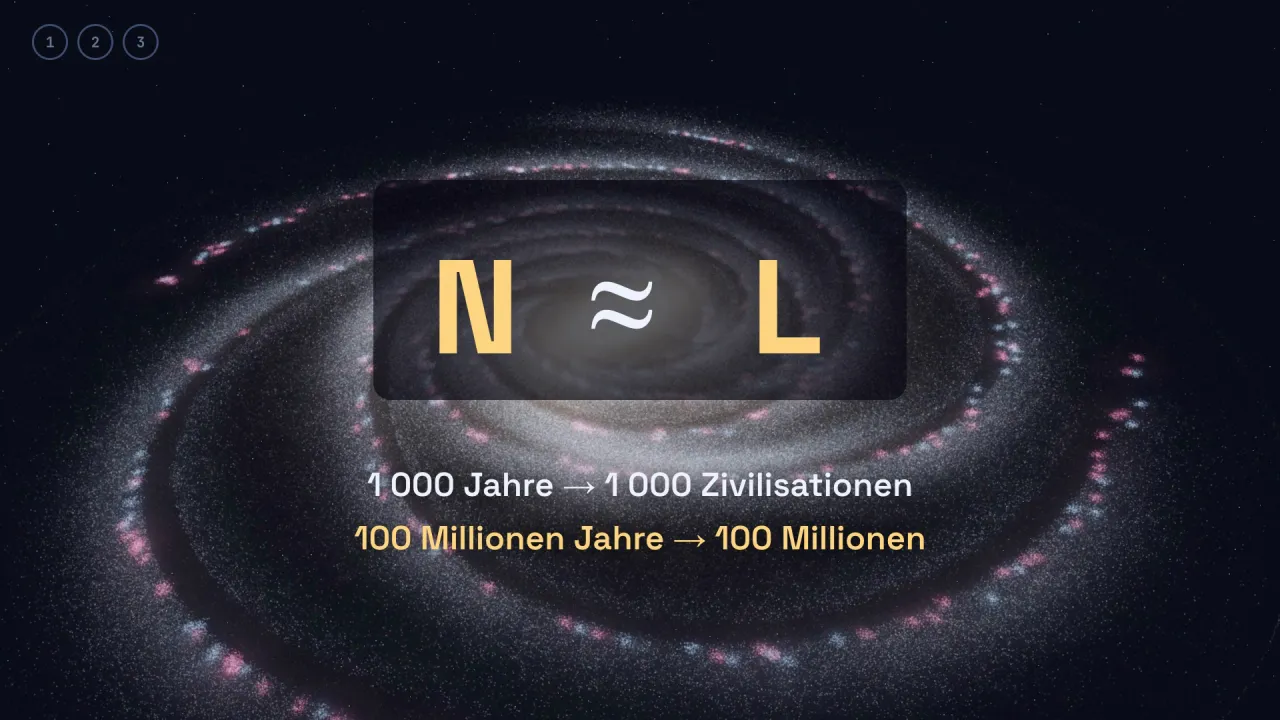
The line has seven symbols. N is what we want to know: how many civilizations in the Milky Way could we detect right now? Six questions lead there. How many new stars form per year? What share gets planets? How many of those are suitable for life? Where does life really appear, where does it become intelligent, and where does it build something you can notice from outside? The seventh symbol, L, asks how long a civilization like that lasts. The whole thing is basically a funnel: stars go in at the top, neighbors come out at the bottom.
In 1961 nobody knows of even a single planet around another star. Still, the ten plug in their best guesses, and the first six numbers together come out to about one. They cancel each other out, and only the L is left. If a civilization lasts a thousand years, there are a thousand. If it lasts a hundred million years, there are a hundred million. So the group’s answer is: somewhere between a thousand and a hundred million civilizations. That’s like a delivery service telling you: your package will arrive in a minute. Or in two months.
They talk for three days. One of them learns partway through that he’s getting the Nobel Prize, and the champagne is already waiting. Another is sure that dolphins can almost talk, and in the end they call themselves the Order of the Dolphin. At the close, the host raises his glass: to the value of L. May it prove to be a very large number. The toast has a serious background. Two days before Drake went to the board, the Soviet Union had detonated the most powerful bomb in history over the Arctic. Anyone drinking to a large L that week is also drinking to us.
But one thing should make you suspicious. By now we’re slowly getting able to measure the symbols at the front, but not the last four. How often chemistry becomes life and how often life becomes intelligence: for that we have exactly one example. Us. And for us, the experiment isn’t over yet. In 1961 people simply assumed that wherever life can appear, it will, and that at some point it starts to think.
That wasn’t a measurement. That was optimism.
In the video from 2:1802
Anything can be proven
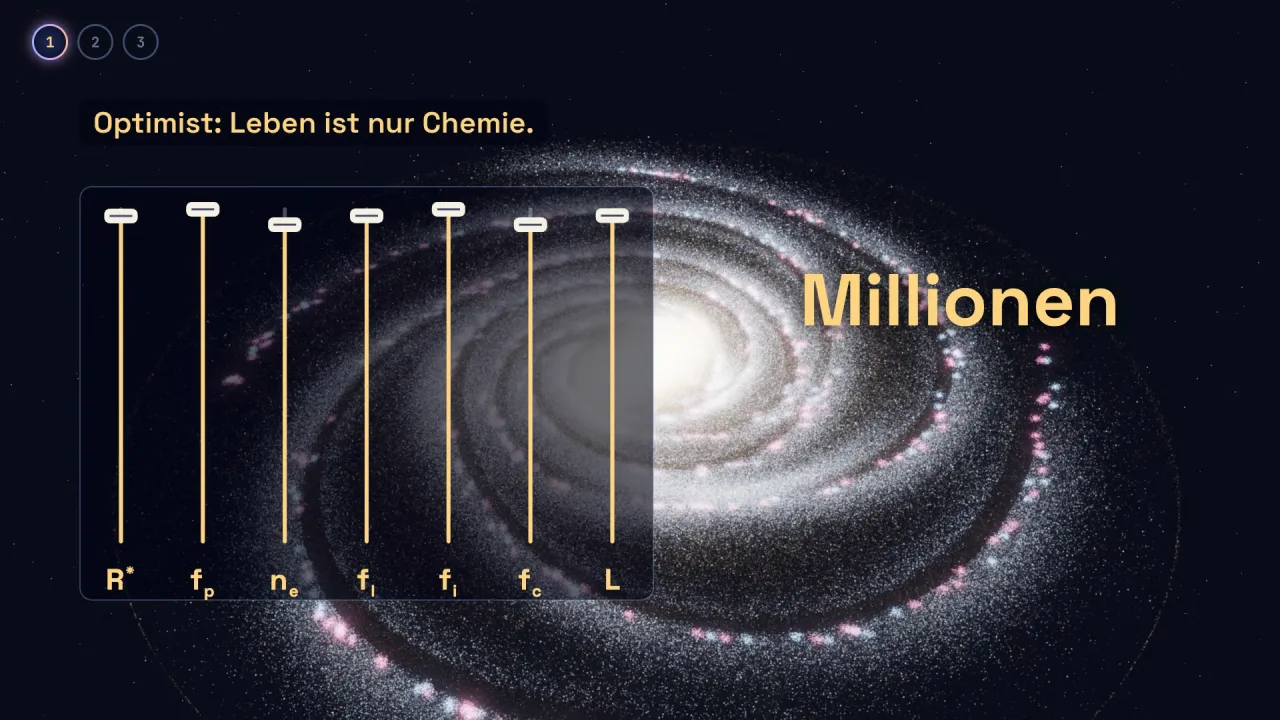
This is where the problem begins. Imagine the seven symbols as seven sliders. The optimist says: life is just chemistry, it happens everywhere. Sliders up, millions of civilizations. The skeptic says: life is a stroke of luck that may have happened exactly once. Sliders down, nobody anywhere. Same equation, and both are doing the math right.
Since Drake, researchers have filled it in dozens of times. The lowest published estimate is three ten-thousandths of a civilization, the highest is a hundred million. That’s what it means to say this equation proves nothing. What you put in at the top comes out at the bottom. If someone tells you the Drake equation shows there are millions of civilizations out there, what it mostly shows is how good a mood they were in when they filled it out.
Drake knew that. For most of the symbols he had no real value. The astronomer Jill Tarter calls the equation a wonderful way to organize our ignorance. But only the many millions from the optimistic calculations make the silence a puzzle in the first place.
What you put in at the top comes out at the bottom.
In the video from 3:5603
Doing the math honestly
For fifty-seven years, almost everyone does the same thing. In 2018 three researchers from Oxford take a look: Anders Sandberg, Eric Drexler and Toby Ord. Their question is almost cheeky. What if the problem isn’t the wrong numbers, but that we’re only plugging in one number at all? Anyone who takes a fixed value for a slider is pretending to know it. But all we know is a range. So the three don’t calculate once. They roll the dice, over and over.
A toy example from their paper, calculated with this series’ lights: two hundred billion stars, nine hurdles on the way to a civilization, and you clear each one with a chance somewhere between zero and twenty percent. The usual way takes the middle, ten percent, multiplied nine times. Result: two hundred civilizations. The chance of an empty Milky Way then has eighty-six zeros after the decimal point, so it’s practically impossible. There it is, the Fermi paradox: someone has to be there, and we don’t see anyone. But if you roll the dice anew for every hurdle and every Milky Way, most of them have someone there, and one in six is empty. From impossible to one in six, just because we stopped pretending we knew.
The reason: when you multiply, a single small value drags everything down. Imagine a village of a thousand people, one of them a billionaire. So on average, everyone in the village is a millionaire. The baker will be thrilled. The average here describes exactly one person. It’s the same with Milky Ways: a few are packed and pull the average up, and it says nothing about most of them.
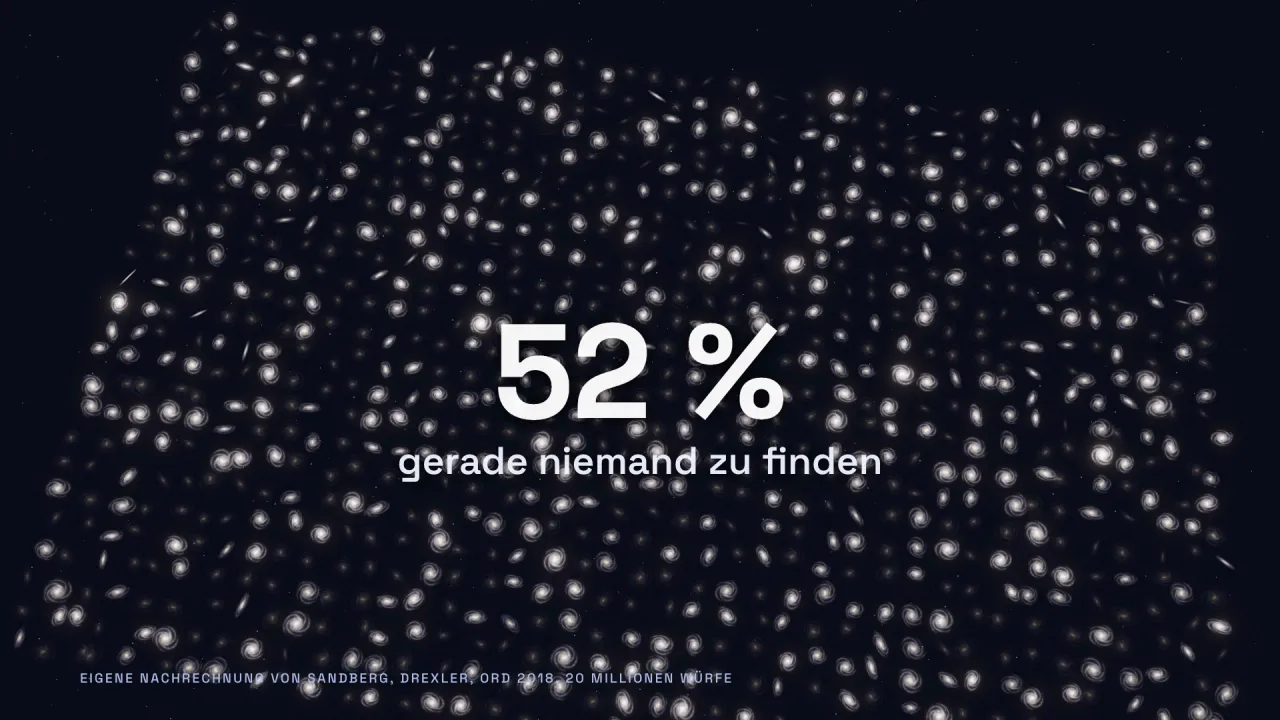
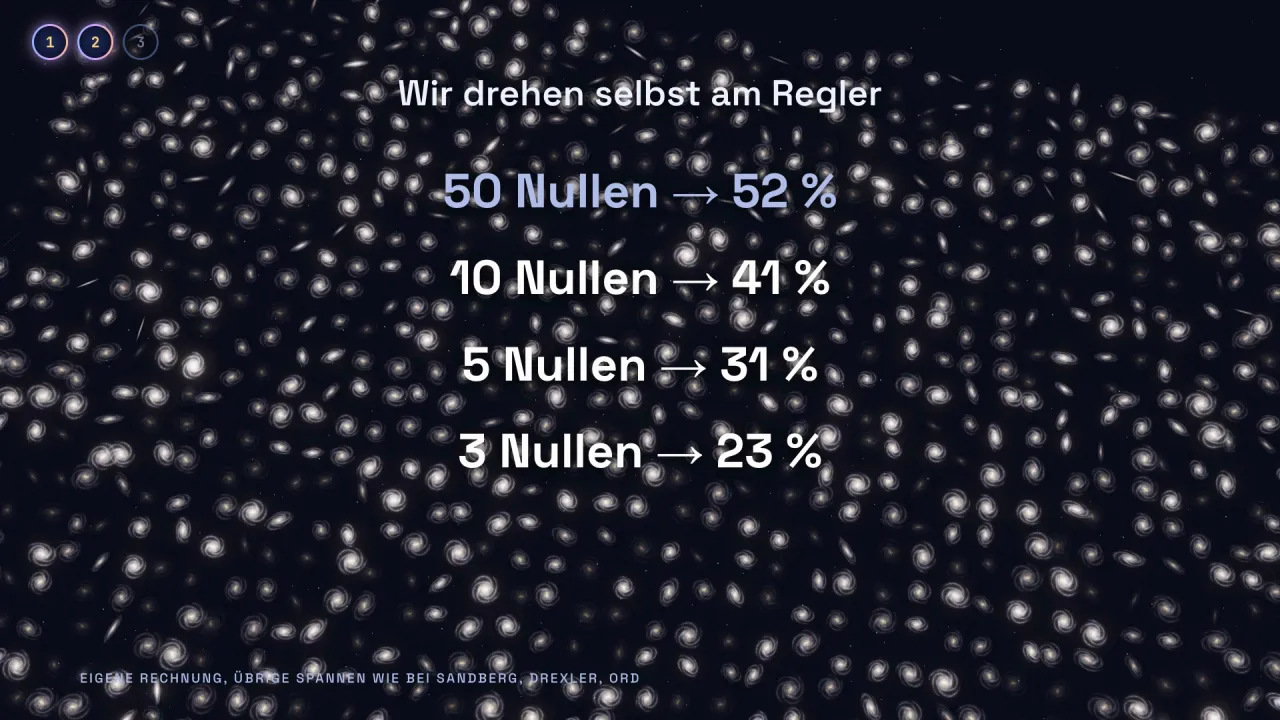
Then the real calculation. For each symbol of the equation, the three take the range that research allows. We recalculated this with twenty million rolls and show a thousand of them in the video, every dot a Milky Way as it could be based on what we know. On average, a Milky Way like this has twenty-seven million civilizations. That sounds like a full house. But 52 percent are dark: in more than every second Milky Way, there’s nobody to be found right now. And in almost four out of ten cases, there’s nobody in the entire visible universe.
And that’s before factoring in what we saw in episode 1. Namely, nothing. If the three add the silence, the number for the Milky Way rises to 53 to 99.6 percent. The highest value comes from Michael Hart’s idea that nobody has ever settled our neighborhood. So if this calculation is right, the silence isn’t a puzzle at all. It’s what you might expect. That’s why their paper is called Dissolving the Fermi Paradox. So you could actually end the series right here. Eleven episodes saved.
If this calculation is right, the silence isn’t a puzzle at all. It’s what you might expect.
In the video from 5:0404
The catch
We look over these three’s shoulders just as closely as Drake’s. Because a single spot does almost all the work: the origin of life. Nobody knows how likely it is. So the three assume an insanely wide range, and their estimate can be off by fifty zeros. That’s their assumption, not a measurement. As far as we can tell, the paper is still a preprint as of November 2026, and critics say: that’s exactly where the result is hiding.
So we turned that slider ourselves. With ten zeros of leeway instead of fifty, 41 percent of the Milky Ways are dark, with five zeros 31, with three zeros 23. And even if life appears everywhere it can, one Milky Way in ten still stays silent. If you only mix the published estimates of other researchers, it’s almost one in three.
So what remains? This calculation doesn’t prove anything either. It doesn’t say: we are alone. It says: if we were alone, that wouldn’t have to surprise us. Fermi asked where everybody is. With honest math, one possible answer is: maybe this “everybody” never existed. There could just as well be millions out there. Both fit what we know. That’s not an excuse. That’s the assignment.
If we were alone, that wouldn’t have to surprise us.
In the video from 8:0305
The rules of the game
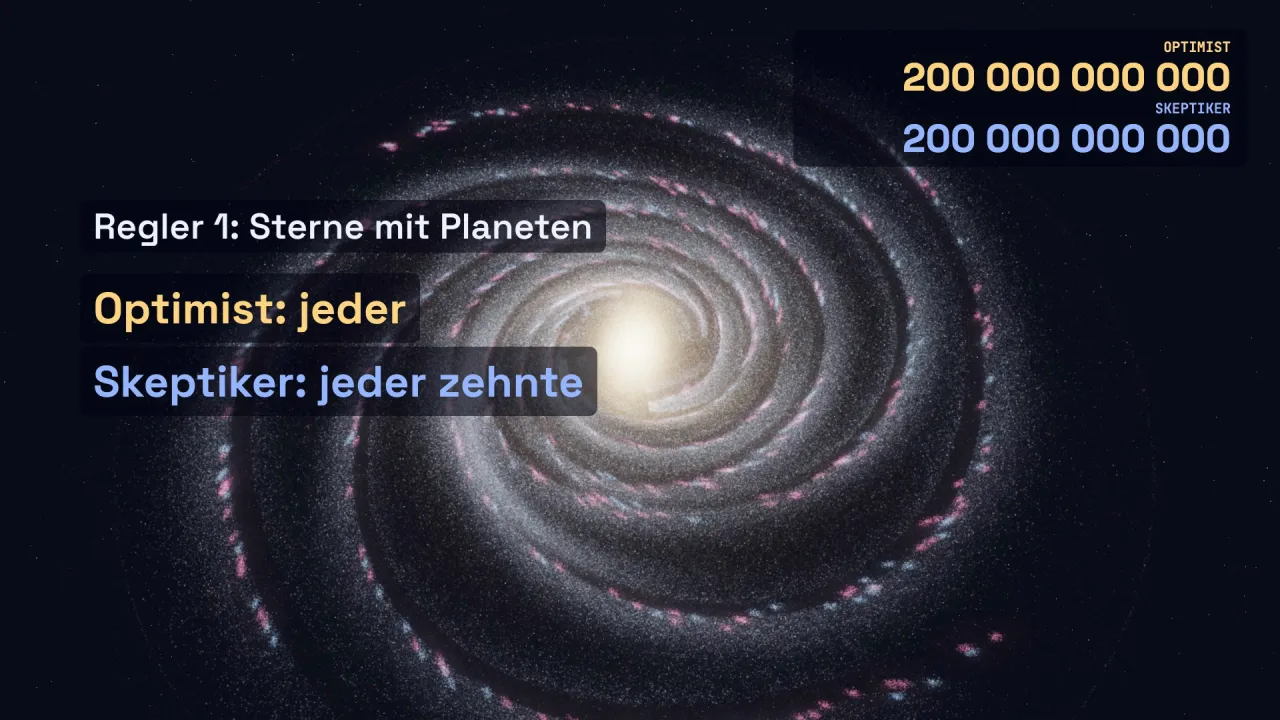
Every slider we know better, we can set more tightly. That’s exactly what the series does from now on, with three rules of the game. First: every episode takes on one slider. Second: there are always two numbers. The optimist takes the upper edge of what research allows, the skeptic the lower. Third: no number without a source, and when something’s an estimate, we say so. We start with the lights from episode 1, two hundred billion, and every slider turns some out.
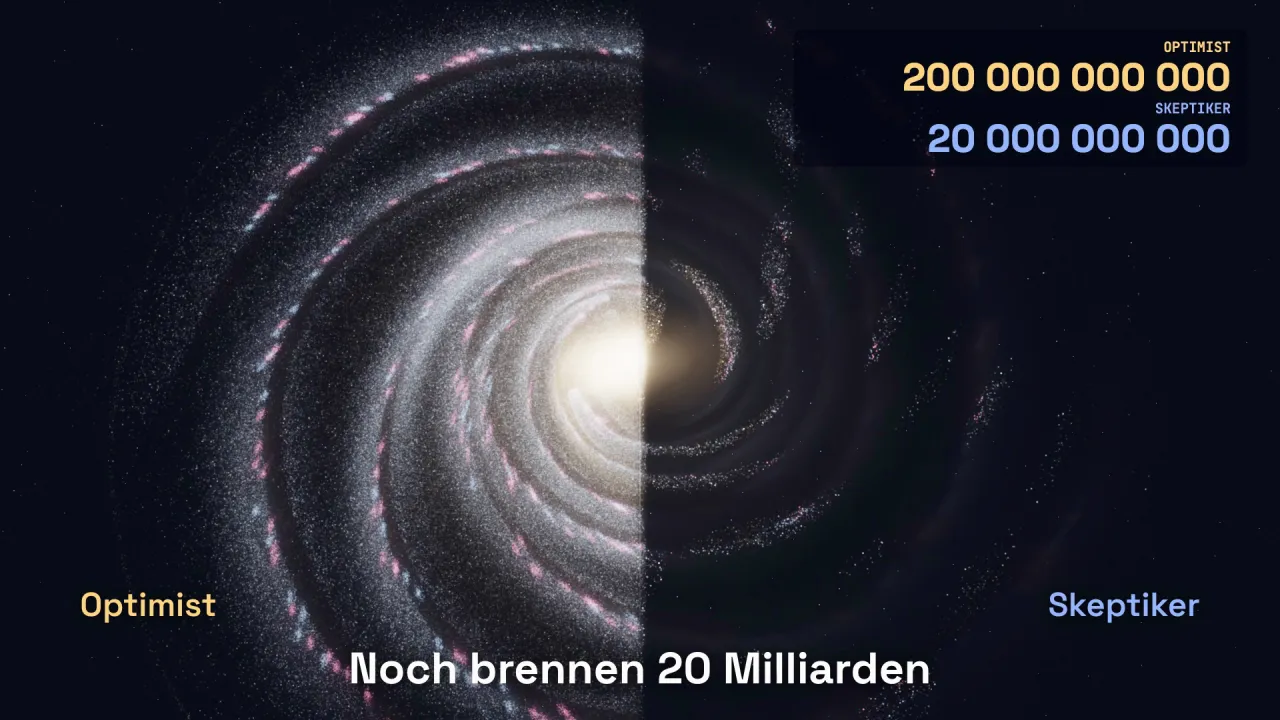
The first slider asks: which stars even have planets? The optimist says: all of them. The skeptic takes the strictest number from Sandberg’s paper: one in ten. That’s probably too strict. But one planet per star on average doesn’t mean that every star has one. Say hi to the village.
No number without a source. And when something’s an estimate, we say so.
In the video from 9:2406
Is there a second Earth?
The tool is ready, and now we go through the first door: nobody’s there. We know of over six thousand alien planets. But is there a second Earth? That’s exactly what the next episode is about.
Until then, the first slider is set. For the optimist, all the lights stay on, two hundred billion. For the skeptic, nine out of ten go out. Twenty billion are still burning.