
01
The world before Einstein
You are on a train doing 100 kilometres per hour and you throw a ball forwards at 20. For someone on the platform it flies at 120. Speeds simply add up. That is how people pictured the world from Isaac Newton onwards: space is space, time is time, and a second is a second everywhere.
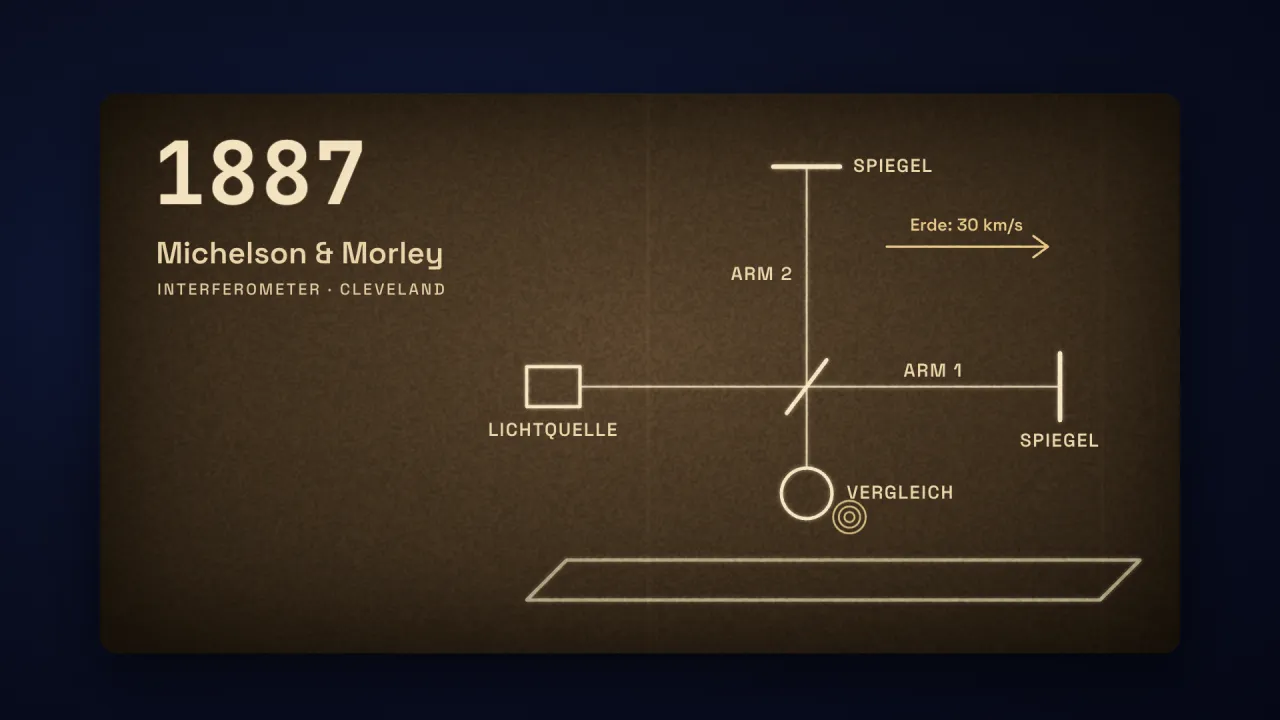
Now the same with light. Someone on the train switches on a torch. The woman on the platform ought to measure around 300,000 kilometres per second plus the speed of the train. But she measures exactly 300,000. Light is equally fast for everyone, no matter how fast the train goes. In 1887 Michelson and Morley tried to measure just such a difference and found nothing.
If light is equally fast for everyone, something else has to give. In 1905 a young clerk at the patent office in Bern had a rather crazy idea about what that might be: time itself.
02
The light clock
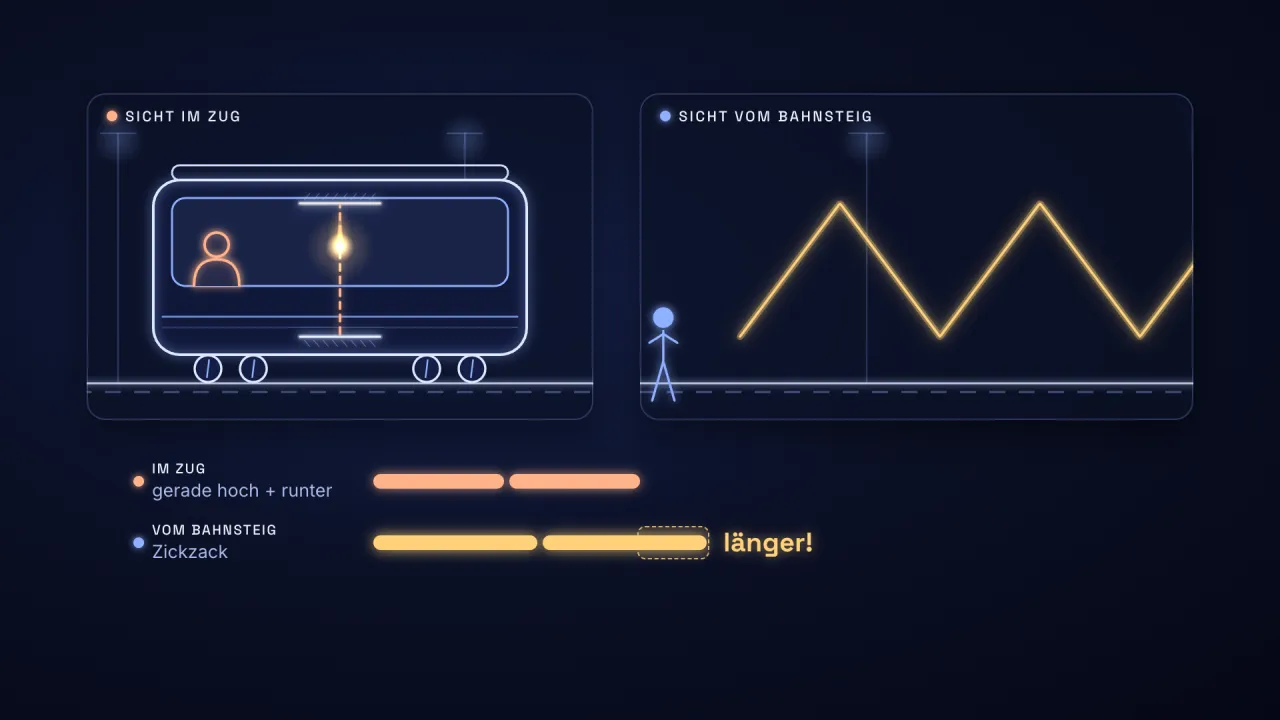
The simplest clock in the world consists of two mirrors with a particle of light between them. It zips up and down, and every time it arrives at the bottom the clock goes: tick.
Put this clock on the train. For the person on the train nothing changes. But the woman on the platform sees something different: while the light flies upwards, the train moves on a little. From her point of view the light zigzags, and that is a longer path.
Longer path, same speed: the light takes longer for each tick. Seen from outside, the clock on the train ticks more slowly. This is no trick. For everything on the train, time really does pass more slowly: for the clock, your heart and every atom. This is called time dilation.
You don’t notice any of this in everyday life. Anyone who spends a whole year on the International Space Station ends up barely nine thousandths of a second younger. But very close to the speed of light the effect shoots up: at 90 percent, time passes more than twice as slowly, at 99 percent seven times as slowly.
Moving clocks run slow.
In the video from 2:5103
Evidence: muons and atomic clocks on planes
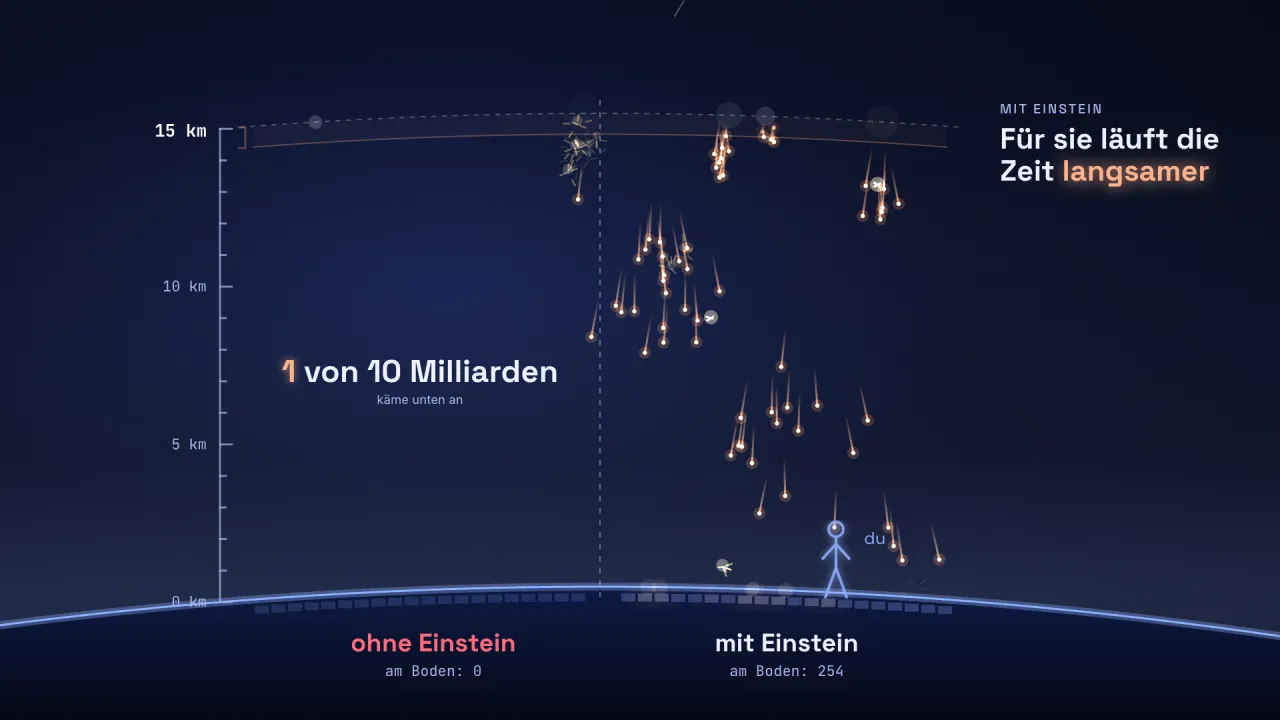
The first proof is raining down on you right now. At a height of about 15 kilometres, cosmic rays hit the atmosphere and create tiny particles called muons. They live for only 2.2 millionths of a second on average. Even at nearly the speed of light they would on average get only about 660 metres in that time. Out of ten billion, barely one would reach the ground.
Yet we measure them on the ground in huge numbers. Because they are so fast, their inner clock ticks so leisurely that they make it all the way down to us.
The second proof is almost a little funny. In 1971 Joseph Hafele and Richard Keating bought plane tickets for themselves and for their atomic clocks, which really did have their own seats. On ordinary scheduled flights they travelled around the world once eastwards and once westwards. Afterwards they compared the clocks with atomic clocks that had stayed on the ground. The clocks differed, only by a few hundred billionths of a second, but exactly as Einstein had predicted.
04
Gravity slows down time
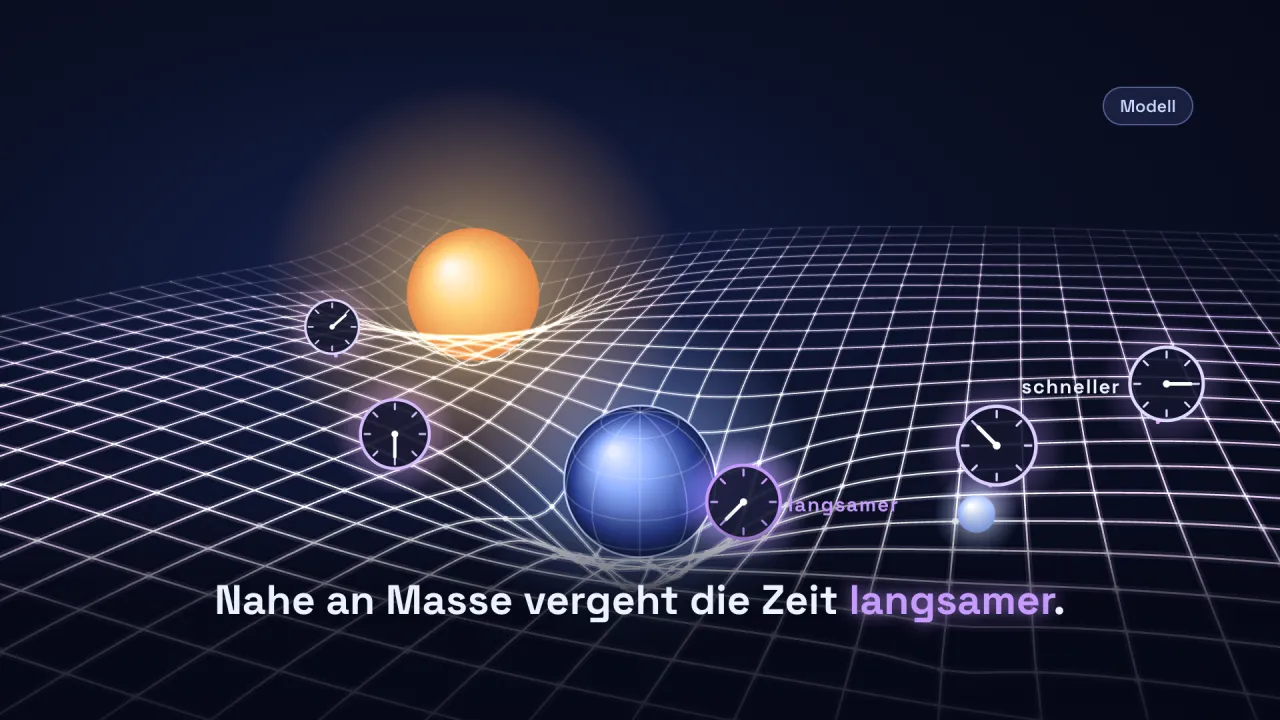
In 1915 Einstein went one step further. Space and time are not a rigid stage but together form a kind of fabric: spacetime. Mass bends this fabric. The picture with the grid is only a comparison, since the real thing is four-dimensional. But the principle is right: the closer you are to a large mass, the more spacetime is curved, and the more slowly time passes there.
This can be measured too. In 2010 researchers in the USA set up two extremely precise atomic clocks with a height difference of 33 centimetres, and the upper one ran faster. These days a single millimetre is enough. So your head is ageing a tiny bit faster than your feet right now.
Gravity slows down time.
In the video from 7:0805
Back to the satnav: the puzzle solved
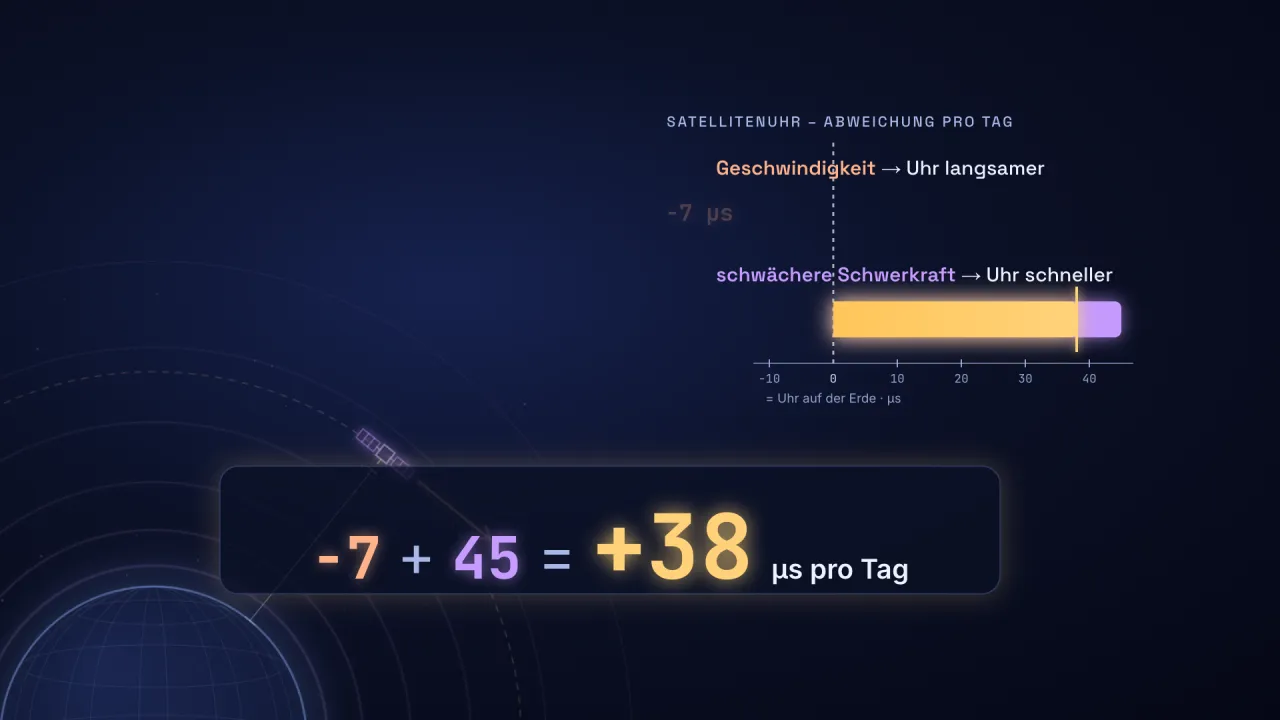
A GPS satellite circles the Earth at a height of around 20,000 kilometres and at about 14,000 kilometres per hour. It is fast, so its clock runs slower by about seven millionths of a second per day. And it is far from the Earth, where gravity is weaker. That makes its clock run faster by about 45 millionths of a second per day. On balance it gains 38 millionths of a second every day.
That sounds like nothing. The blink of an eye lasts around ten thousand times as long. But GPS measures how long the signals take to get from the satellites to your phone, and those signals travel at the speed of light. In 38 millionths of a second, light covers more than eleven kilometres.
That is why engineers set the satellite clocks a tiny bit slower before launch. They tick very slightly wrong on Earth so that they keep exactly the right time in space.
Every time you use your satnav, Einstein is doing the maths.
In the video from 8:24