
01
The journey to the nearest star
Mia and Max are twins, both 30 years old. Mia boards a spaceship and flies to Proxima Centauri, the star closest to us. “Closest” here means 4.2 light years. She travels at 80 percent of the speed of light, turns around at her destination and comes back. For Max on Earth, that takes about ten and a half years.
On board she has the light clock from the first episode: a particle of light bouncing between two mirrors. Seen from Earth, it has to travel a longer, slanted path. At this speed that means: while Max’s clock ticks five times, Mia’s ticks only three times.
This applies to everything on board: her heartbeat, her coffee going cold, her hair growing. Mia notices nothing. But by the end she has only lived through a good six years of the journey. From her point of view the distance shrinks instead: at her speed, the way to the star is only two and a half light years long.
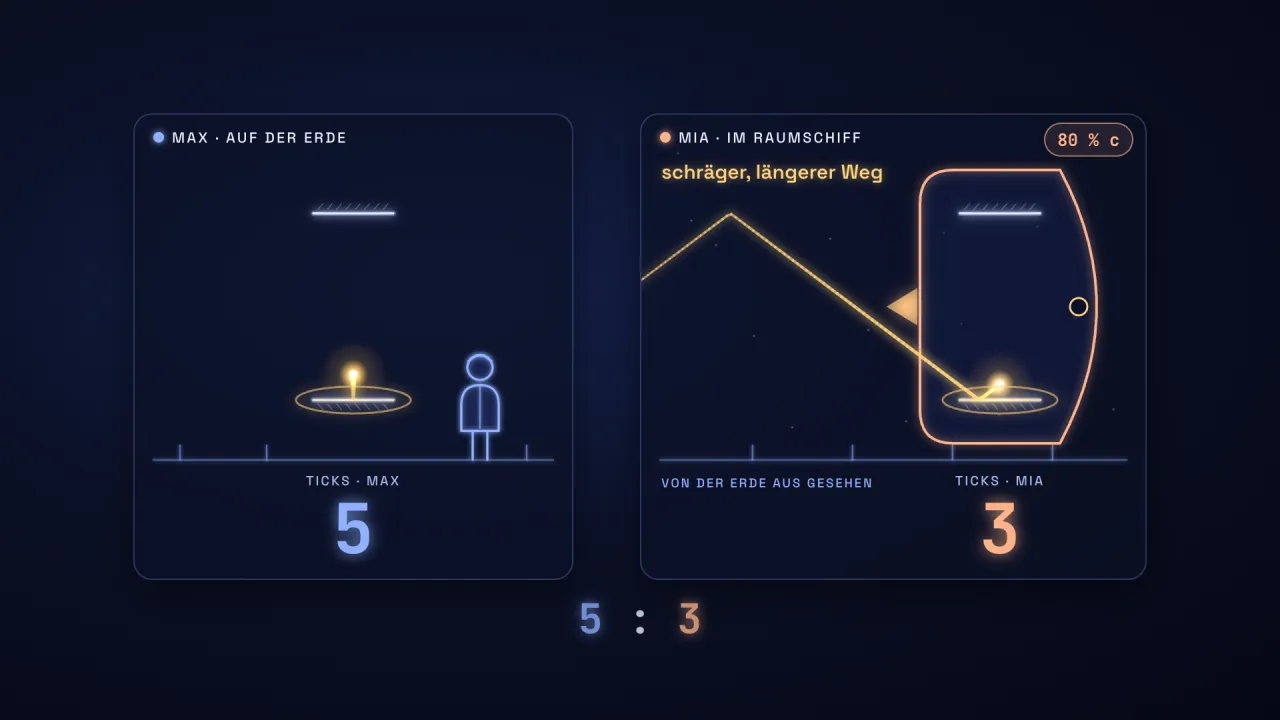
What Max sees as a slower clock, Mia experiences as a shorter journey.
In the video from 1:1902
The paradox: who is really younger?
Now for the catch. Einstein says motion is relative. There is no place in the universe that truly stands still. From Mia’s point of view she is sitting calmly in her spaceship while the Earth and Max rush away. So Max’s clock should run slow and Max should be younger. But they can’t both be younger than the other.
The solution lies in a small detail: the two are not on an equal footing. Max stays where he is the whole time. Mia has to brake at the star, turn around and accelerate again. She can feel that, she gets pressed into her seat. Max feels nothing at all.
Imagine space and time as a single map: spacetime. Max’s path on it is a straight line, Mia’s has a bend. On an ordinary map the detour would be longer. In spacetime it is exactly the other way round: the most time passes on the straight path.
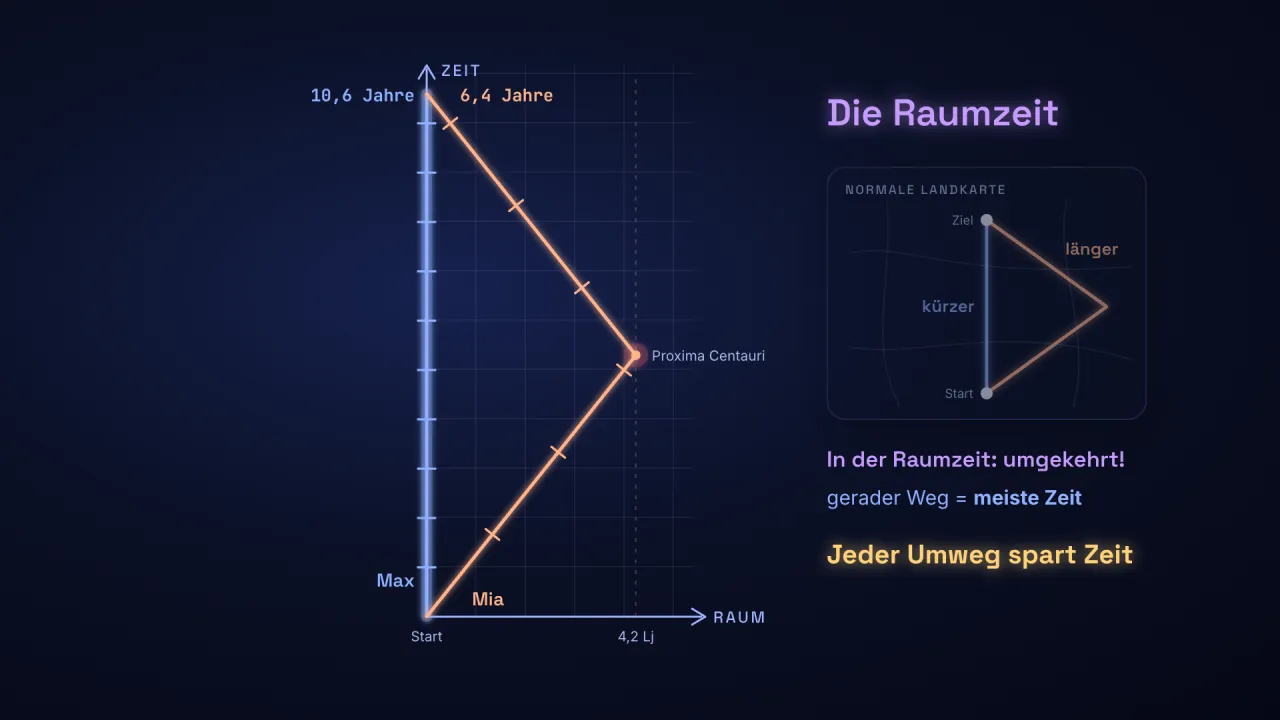
In spacetime the straight path is the longest. Every detour saves time.
In the video from 2:4903
Birthday flashes of light
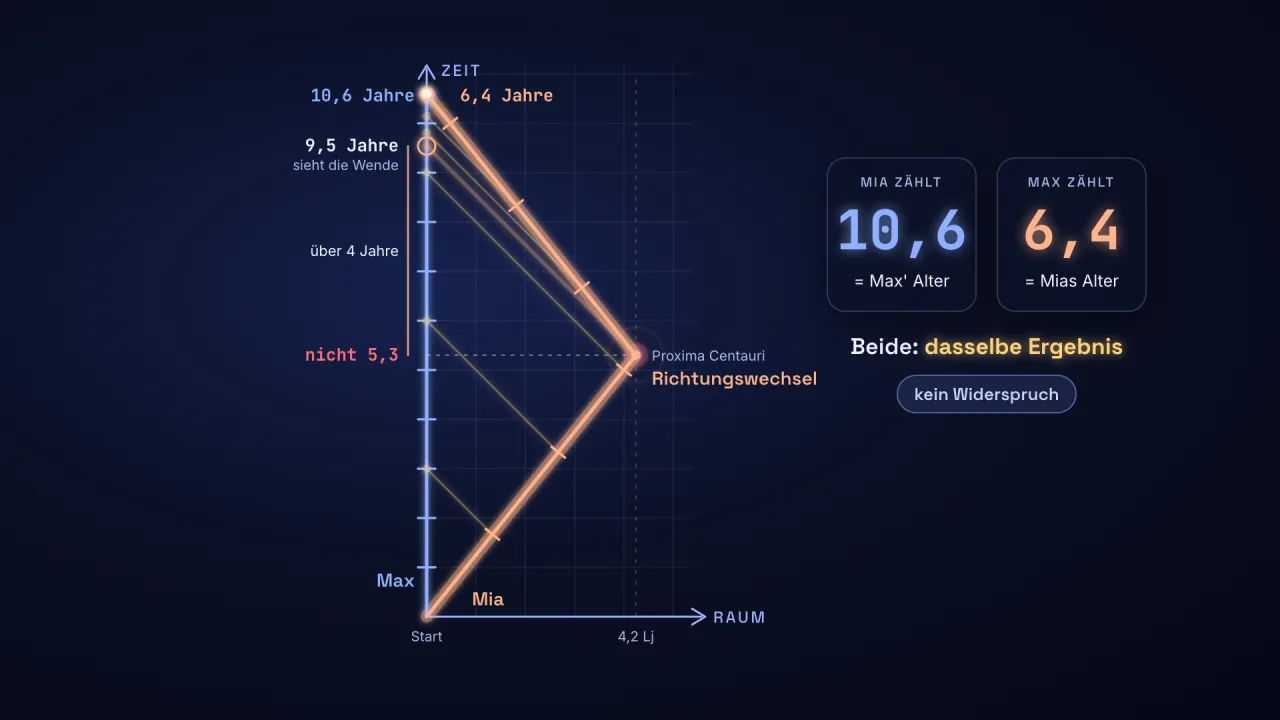
You can check this. Mia and Max send each other a flash of light on every birthday. On the way out Mia is flying away from the flashes, so they arrive stretched out, only one every three years. On the way back she races towards them and three arrive per year. The switch happens exactly halfway through her journey. That makes about one flash on the way out and nine and a half on the way back, ten and a half in total. Which is exactly how much older Max has become.
At first Max also sees Mia’s flashes stretched out. But he only finds out about her turnaround when the light from it reaches him, and that takes over four years. So he doesn’t see the switch after five years but only after nine and a half, shortly before she lands. In total he counts a good six flashes. Which is exactly how much older Mia has become.
04
Does it really happen?
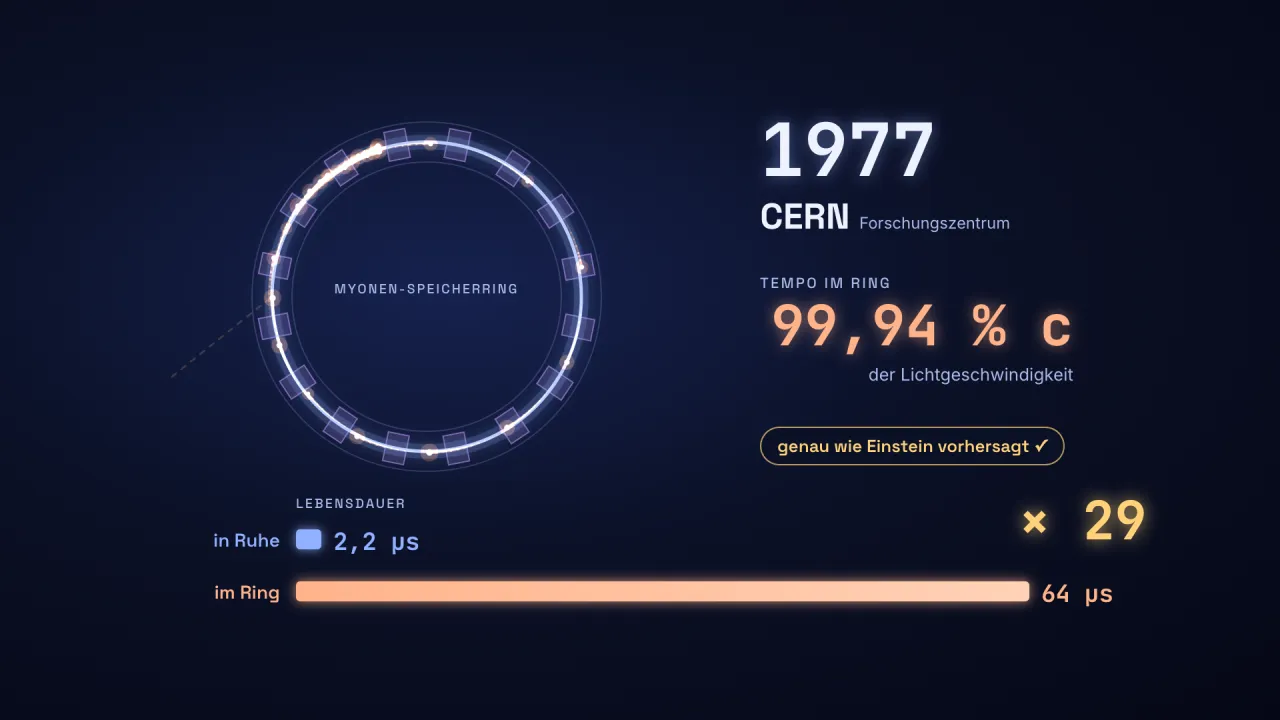
In 1977, at the CERN research centre, muons were sent racing around a ring at 99.94 percent of the speed of light. Normally these tiny particles decay after about two millionths of a second. In the ring they lived almost thirty times as long, exactly as Einstein predicted.
The experiment reveals something else. The muons in the ring are constantly being whipped around, far more violently than Mia at her turnaround. Yet only their speed counts for their clock. Acceleration itself doesn’t slow the clock down. It really is all about the path through spacetime.
And there are real twins in space: the NASA astronauts Scott and Mark Kelly. Scott spent almost a whole year in a row on the International Space Station, at around 28,000 kilometres per hour. Mark spent far less time in space and was the comparison on Earth in a big twins study. Scott did become younger as a result, by about a hundredth of a second.
05
A journey into the future
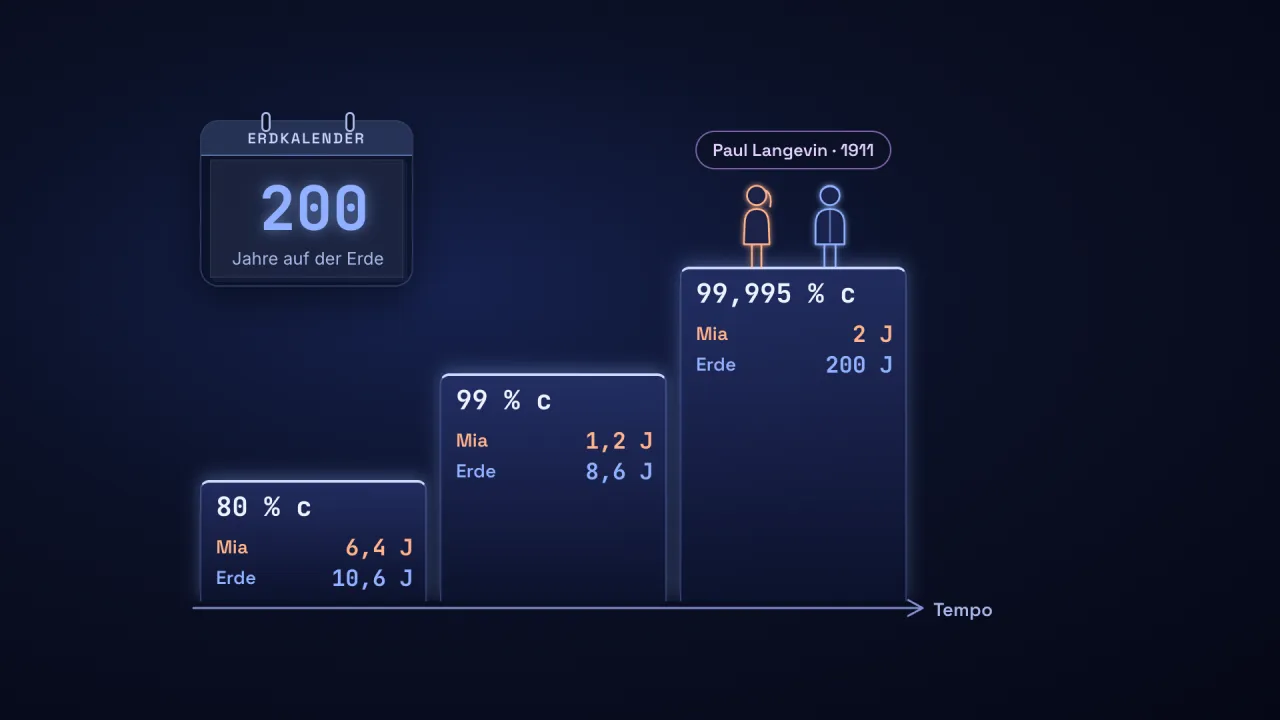
Strictly speaking, Mia’s trip is a journey through time into the future, and the faster she flies, the further she gets. At 99 percent of the speed of light the whole trip takes her only a little over a year, while more than eight pass on Earth. In 1911 the physicist Paul Langevin worked it out: two years on the road and you land on an Earth that is 200 years further on. That idea grew into the twins we talk about today.
Sadly there are two catches. We are far too slow: our fastest spacecraft, the Parker Solar Probe, doesn’t even reach a thousandth of the speed of light. And it is a one-way trip. Mia can never catch up with Max again. She will always be the younger twin.
So time travel really exists. Just in one direction.
In the video from 6:53
