01
A sky full of suns
Imagine you are standing in the middle of a huge forest. In every direction you first see a few trees with gaps in between. But behind every gap there are more trees, and behind those even more. If the forest is big enough, wherever you look your gaze will sooner or later land on a trunk. All around you there is nothing but bark.
It’s the same with stars, except that the forest of stars extends in all directions, upwards too. Distant stars are fainter, of course: a star twice as far away shines only a quarter as brightly. But a shell of the same thickness at twice the distance also holds four times as many stars. The two cancel out exactly. Every shell of stars sends us the same amount of light, no matter how far away it is. And if space is infinitely large, there are infinitely many shells.
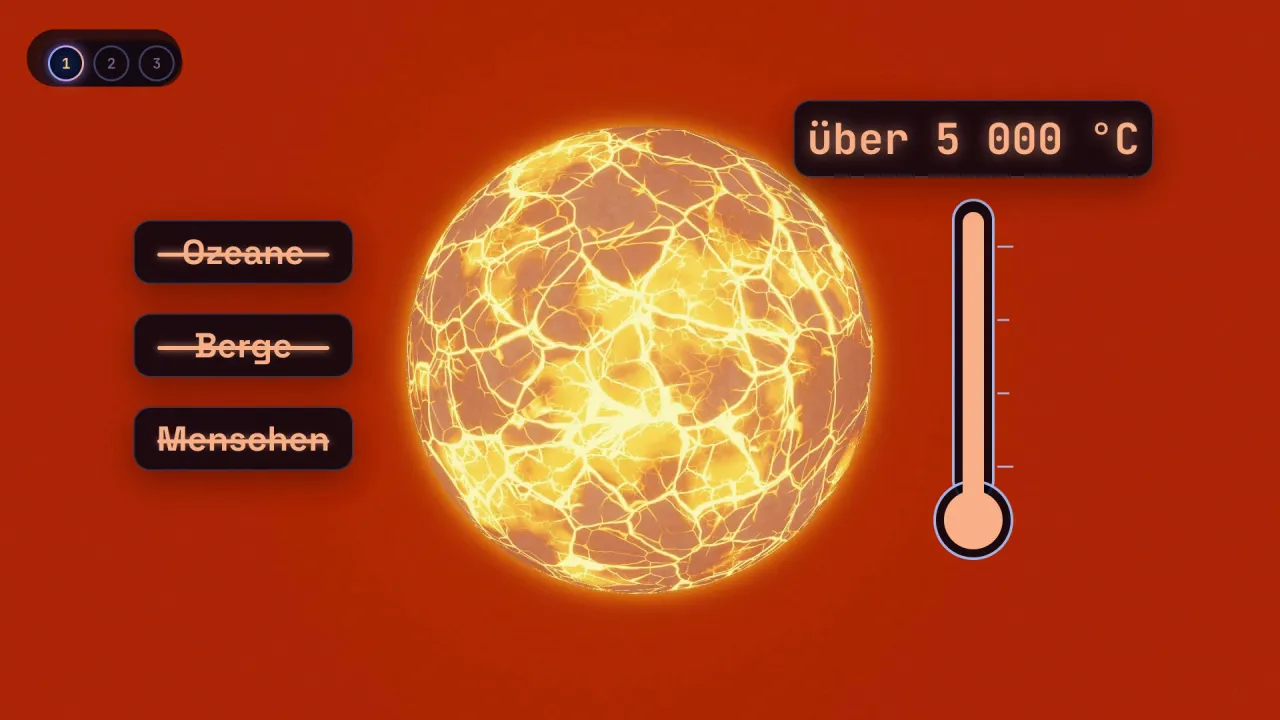
The sky above you has room for around 92,000 solar discs. In a universe like that, every single spot would blaze as brightly as the surface of the Sun, day and night. The Earth would heat up until it was as hot as the Sun itself, more than 5,000 degrees Celsius. No oceans, no mountains, no people.
But we are still here. So something about this calculation must be wrong.
In the video from 1:2202
False leads
The problem is old. Johannes Kepler described it as early as 1610: if space were infinite and full of suns everywhere, the sky would have to be bright. But it isn’t, so, Kepler concluded, space is not infinite. A good hundred years later Edmond Halley, the one with the comet, and the young Swiss astronomer Jean-Philippe Loys de Chéseaux did the sums again. Both arrived at the same bright sky.
The puzzle was made famous by a doctor from Bremen: Heinrich Wilhelm Olbers. Downstairs in his house he had his practice, upstairs his observatory, and at night he discovered two of the very first asteroids, Pallas and Vesta. In 1823 he wrote about the dark sky. His solution: dust between the stars swallows the light. Sounds good, but it’s wrong. Dust that swallows light warms up, and sooner or later it glows as brightly as the stars itself. Even so, the puzzle is still named after him, Olbers’ paradox, although he was neither the first nor had the right solution. The name was only coined in 1952, by Hermann Bondi.
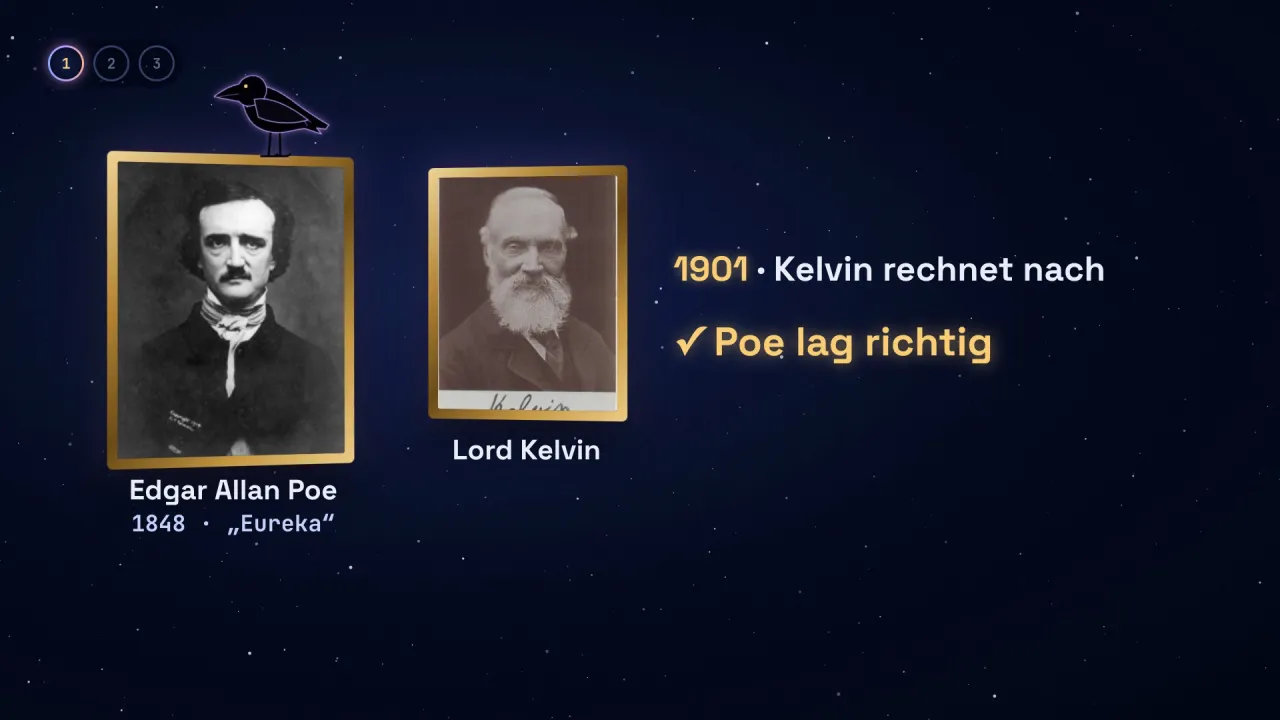
The right idea came, of all people, from a poet: Edgar Allan Poe, famous for his poem “The Raven” and his horror stories. In his work “Eureka” in 1848 he wrote, roughly speaking, that the background of the sky might be so far away that its light has not yet reached us. At the time many people thought that was nonsense. It was only worked out properly in 1901, by Lord Kelvin. And Poe was right.
03
The light is still on its way
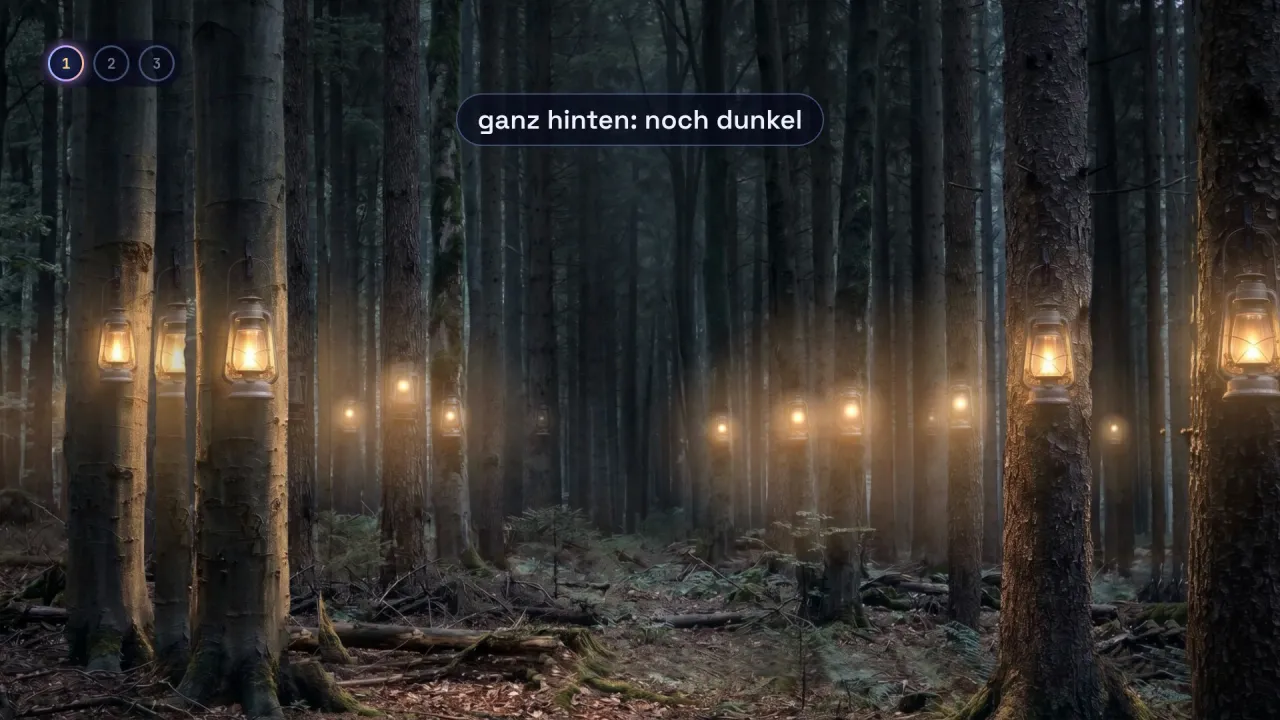
The solution has to do with something you know from the last episode: light takes time. Picture the forest once more. It is pitch dark, and a lantern hangs on every tree. They all switch on at the same moment. At first you only see the lanterns right around you, then more and more, further and further away. But right at the back it stays dark, because their light is still on its way to you.
That is exactly how it is in the universe. It is not infinitely old but about 13.8 billion years. So we only see light that has been travelling for that long at most. Everything beyond is still on its way. And the stars are so incredibly far apart that light would have to travel trillions of times longer than the universe has existed for our gaze to really land on a star in every direction.
Even if we waited, it wouldn’t help: stars don’t shine forever. Our Sun has fuel for about ten billion years. For the sky to become bright, stars would have to shine trillions of times longer. There isn’t enough fuel in the whole universe for that.
On top of that comes a second effect: the universe is expanding. Distant galaxies are moving away from us, and the further away they are, the faster they go. Their light is stretched on its way to us like a rubber band. Blue turns red, red turns into invisible infrared. Astronomers call this redshift. Stretched light carries less energy, so the sky gets darker still.
The main reason for the dark sky: the universe is too young, and stars live too briefly.
In the video from 4:3504
The sky glows after all
In 1964 two radio astronomers, Arno Penzias and Robert Wilson, are working with a huge horn antenna in Holmdel, New Jersey. They pick up a faint hiss that simply won’t go away, no matter where they point the antenna, day and night. They search everywhere for the fault and even find pigeons nesting in the antenna. They clean out their droppings, but the hiss remains.
What the two of them had picked up was the oldest light in the universe: the cosmic microwave background. It comes from every direction, perfectly evenly. In 1978 it earned them the Nobel Prize in Physics.
Until 380,000 years after the Big Bang the whole universe was a glowing fog, at the end still almost 3,000 degrees hot. It shone like the filament of an old light bulb. In every direction you look today, your gaze ends at this fog. Just as Olbers expected, the sky really is bright everywhere. Only the universe has expanded more than a thousandfold since then, and the light was stretched along with it. The orange glow turned into microwaves, the same kind of light you used to melt chocolate in the last episode. Only much weaker, and colder than minus 270 degrees Celsius.
You may even have seen this light already. When an old television with an aerial couldn’t find a channel, snow flickered across the screen. A small part of it, about one percent, was the afterglow of the Big Bang. And it is still here: in every bit of space the size of a sugar cube, around 400 particles of light from that time are flying around right now.
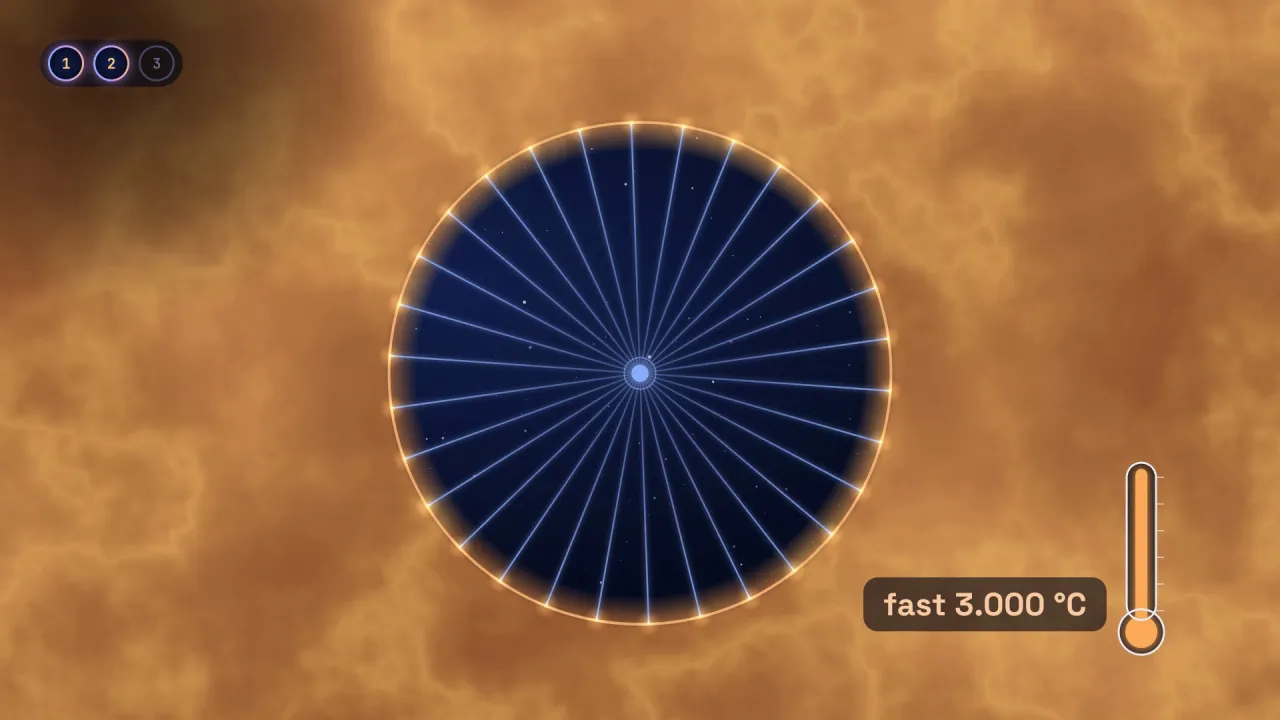
Olbers was right after all: the sky is bright everywhere. It just shines in microwaves today.
In the video from 6:2505
A completely different messenger
No light reaches us from further back than this glowing fog. But light is not the only messenger from space. There is a completely different one: a trembling of spacetime itself. Einstein predicted it in 1916, but for a long time he doubted it could ever be measured.
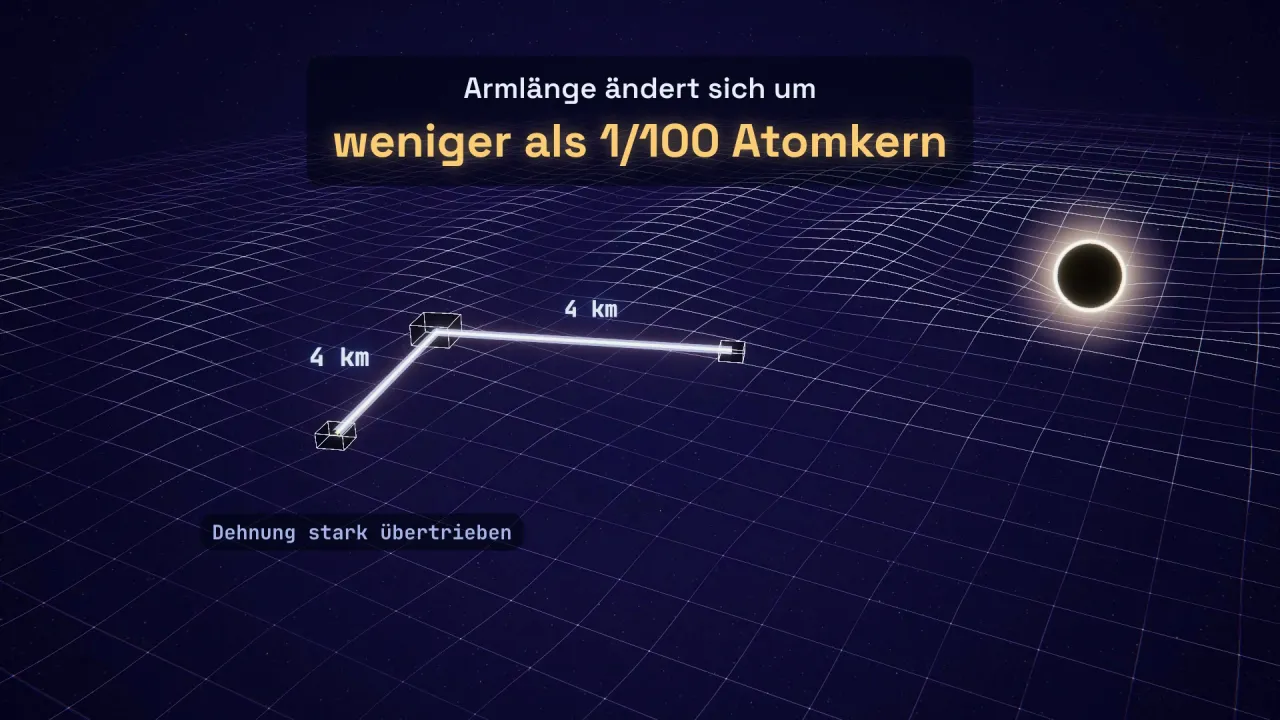
On 14 September 2015 it was felt for the first time, set off by two black holes merging with each other. The trembling that reached us changed the four-kilometre measuring arms of the detector by less than a hundredth of an atomic nucleus. How you measure something like that is the subject of the next episode.