01
Unimaginably fast
Light travels 299,792 kilometres in one second, almost 300,000. That would take it seven and a half times around the Earth. It reaches the Moon in a little over a second and the Sun in a little over eight minutes. And even in a billionth of a second it still gets 30 centimetres. That is exactly why your satnav has to calculate so precisely.
Since 1983 this number has been fixed exactly: 299,792,458 metres per second. Because since then the metre has been defined by light, as the distance light travels in 1/299,792,458 of a second.
That only applies in empty space, though. In water light is a quarter slower, in glass a third, and in diamond it doesn’t even manage half. Internet data also travels as light through glass fibres, at about two thirds of the speed of light.
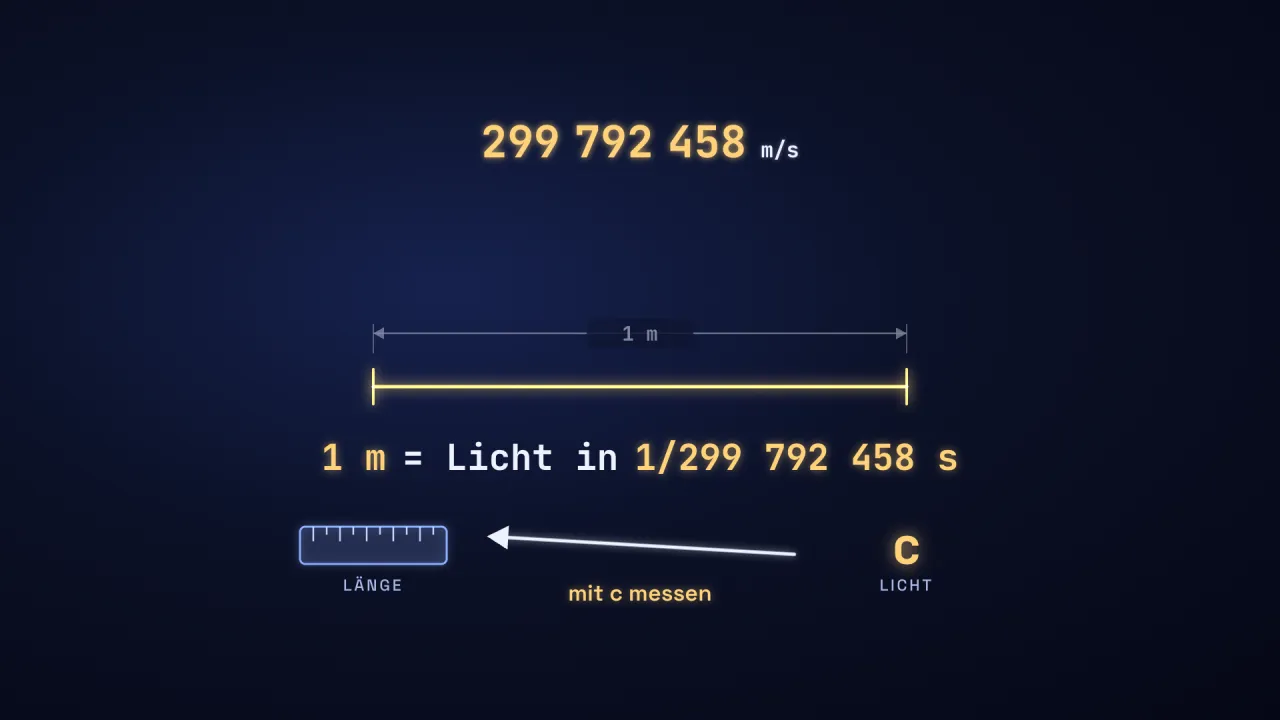
These days nobody measures the speed of light any more. We measure with it.
In the video from 1:0902
How do you measure it?
For a long time people thought light was simply there instantly. Galileo Galilei proposed an experiment with two lanterns on two hills: one person uncovers their lantern, the other responds as soon as they see the light. The result: far too fast. People react thousands of times more slowly than light travels.
The first proof came from the Dane Ole Rømer in Paris in 1676. Jupiter’s moon Io regularly disappears into Jupiter’s shadow, like clockwork. But whenever the Earth was moving away from Jupiter, it was late. Rømer realised: light simply takes longer for the longer path. For 9 November 1676 he predicted an eclipse ten minutes later than everyone else, and he was right.
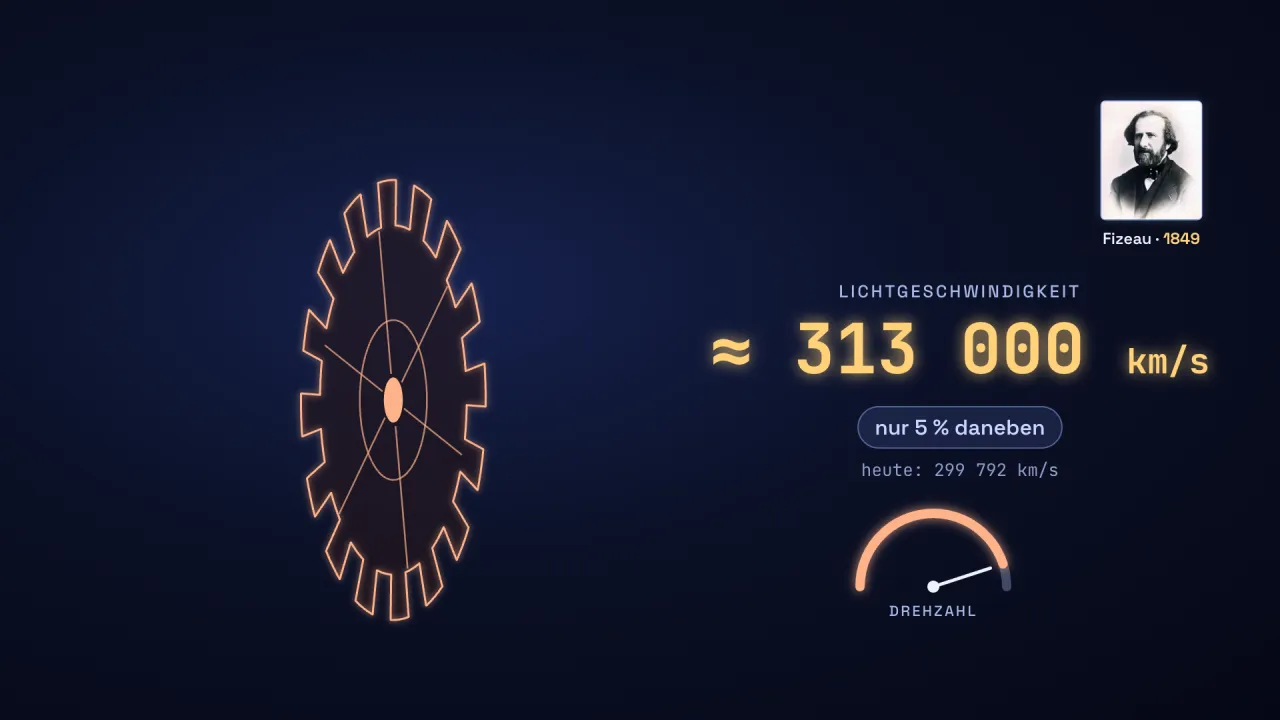
The first measurement on Earth was made by Hippolyte Fizeau in Paris in 1849. He sent light through a cogwheel with 720 teeth, almost nine kilometres to a mirror on Montmartre and back again. Then he spun the wheel faster and faster, until the returning light no longer came through the gap but hit the next tooth. From the speed of the wheel he worked out the speed of light: around 313,000 kilometres per second, only five percent off.
Today we fire lasers at the Moon. The Apollo 11 astronauts set up a mirror there that still works. A laser pulse flies there, gets reflected and is back after two and a half seconds. That is how we know the Moon moves almost four centimetres further away from us every year.
03
Measure it yourself
You need a microwave, a bar of chocolate and a ruler. The trick: microwaves are light too, invisible light that oscillates back and forth inside the oven. That is why the chocolate doesn’t melt everywhere but in individual spots.
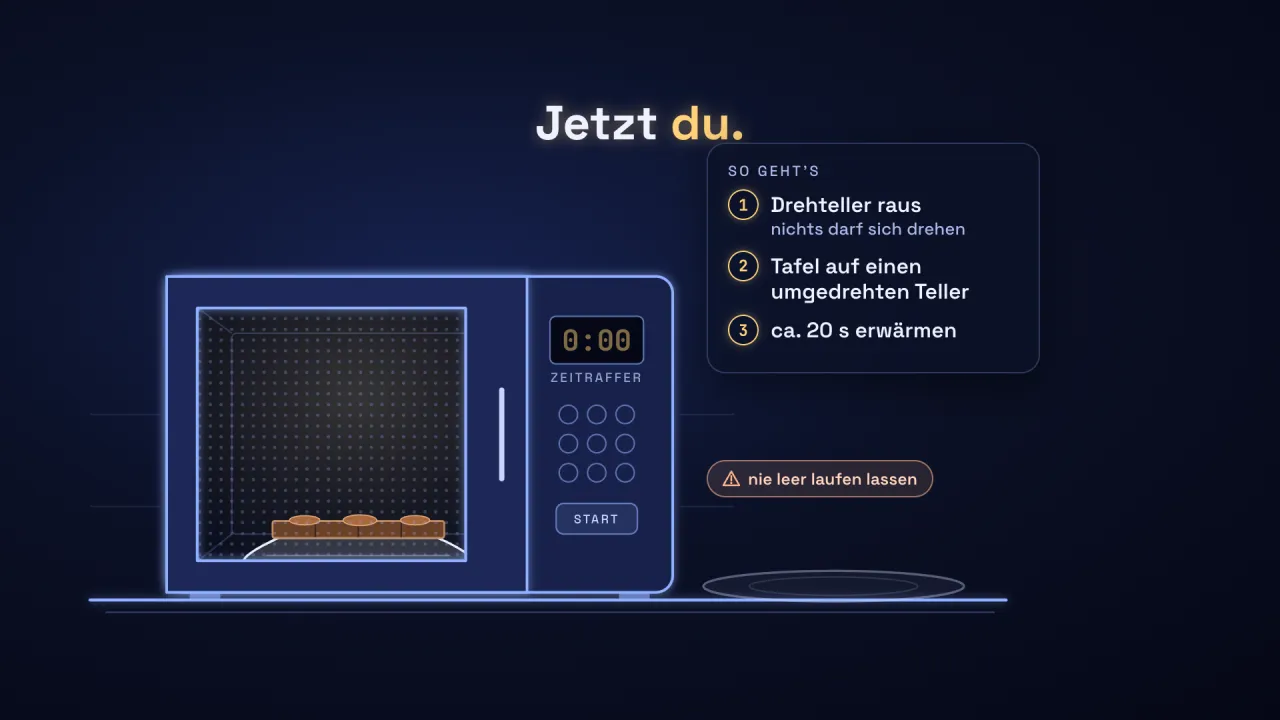
- 1 Take out the turntable, the chocolate has to stay still.
- 2 Place the bar on an upside-down plate.
- 3 Heat for about 20 seconds, until the first spots go soft.
- 4 Measure the distance between two soft spots, usually around 6 centimetres. That is half a wave, so double it: 12 centimetres.
- 5 Multiply by the frequency on the rating plate, usually 2,450 MHz, or 2.45 billion oscillations per second.
Never run the microwave empty. Only heat briefly, the plate can get hot.
12 centimetres times 2.45 billion is around 294,000 kilometres per second. Congratulations, that is the speed of light. And you get to eat the chocolate afterwards.
In the video from 3:5904
A glimpse into the past
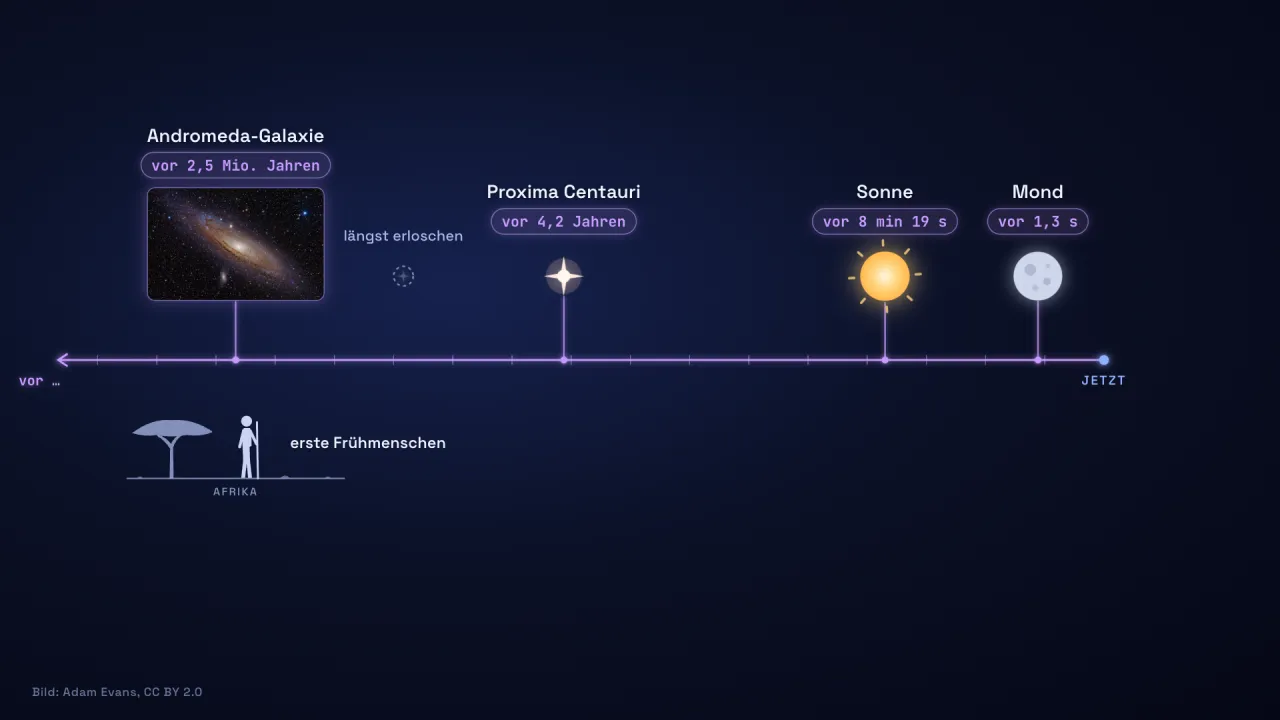
Because light takes time, every look at the sky is a look back. You see the Moon as it was a good second ago and the Sun as it was eight minutes ago. You see the nearest star, Proxima Centauri, as it was a good four years ago. And the Andromeda galaxy as it was two and a half million years ago. When its light set off, the first early humans were living in Africa.
With the James Webb Space Telescope we can go much further. The record is held by the tiny galaxy MoM-z14, whose light travelled for about 13.5 billion years. We see it as it looked only 280 million years after the Big Bang.
Further back still there is light that comes from everywhere at once: the cosmic microwave background. It was emitted when the universe was 380,000 years old. Before that everything was so hot and dense that no light could get through, as in a fog. That is the limit. We cannot look further into the past with light.