
01
Too heavy for light
Throw a ball into the air and it falls back down. The harder you throw, the higher it goes. From about eleven kilometres per second it doesn’t come back at all. That is the Earth’s escape velocity.
Squeeze the Earth smaller and smaller with all its mass, and you have to go faster and faster to get away. Once it is only the size of a marble, not even the speed of light is enough. Nothing gets out any more. The Sun would have to be squeezed down to six kilometres.
The first person to work this out was Karl Schwarzschild, director of the observatory in Potsdam. At the end of 1915 he was a soldier in the First World War, solving Einstein’s new equations between deployments. A few months later he died. His solution still describes every black hole that doesn’t spin. The name “black hole” has only existed since 1967.
The boundary beyond which nothing comes back is called the event horizon. If you watch a clock fall in from outside, it ticks slower and slower, its light gets redder and fainter, and at the horizon it seems to stop. The clock itself notices nothing. It just never comes back.

02
The shadow
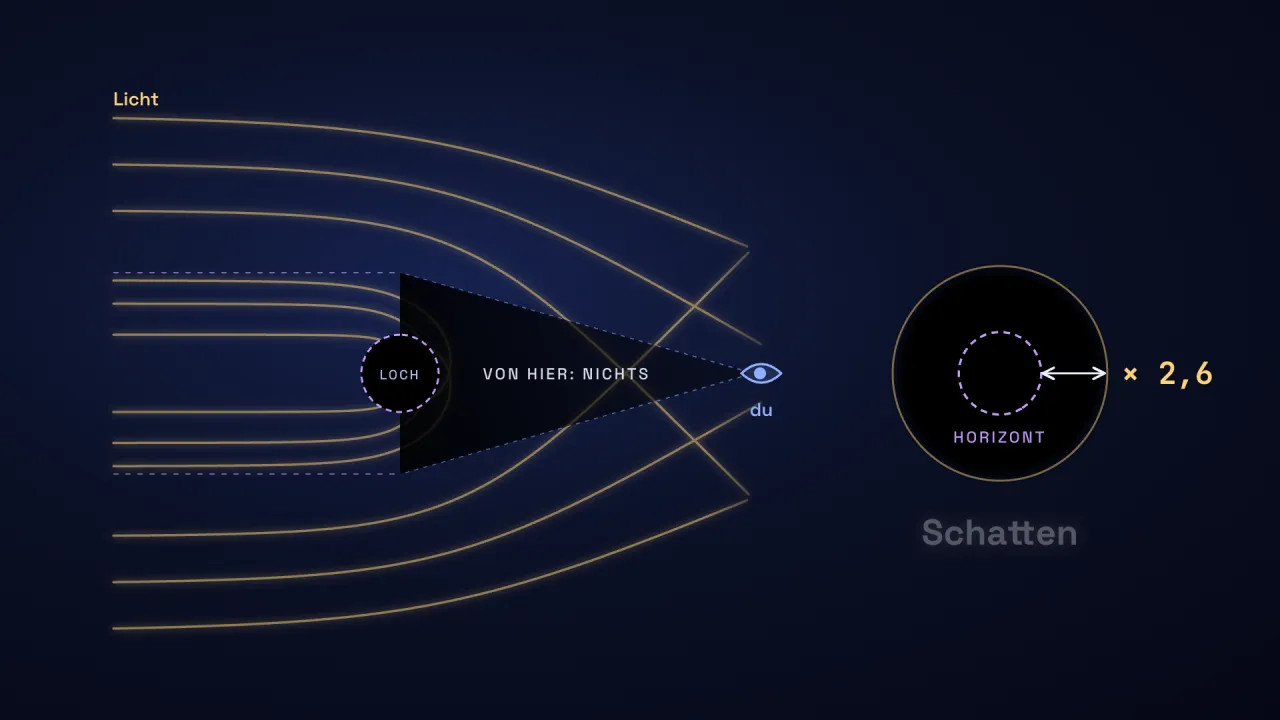
If you float at a safe distance from a black hole, you actually see nothing: black against black space. But the hole gives itself away, because it bends the light of everything behind it. The stars around it shift, get distorted and doubled, as if you were looking through a giant piece of glass.
The black patch you see is a good two and a half times as big as the hole itself. Light flying close by is deflected so strongly that it falls in. So from that whole direction nothing reaches you. Astronomers call this patch the shadow.
A little outside the horizon, light can even orbit the hole like a moon. If you stood there and looked straight ahead, you could in principle see the back of your own head. This circling light forms a wafer-thin bright ring at the edge of the shadow.
03
A ring of light
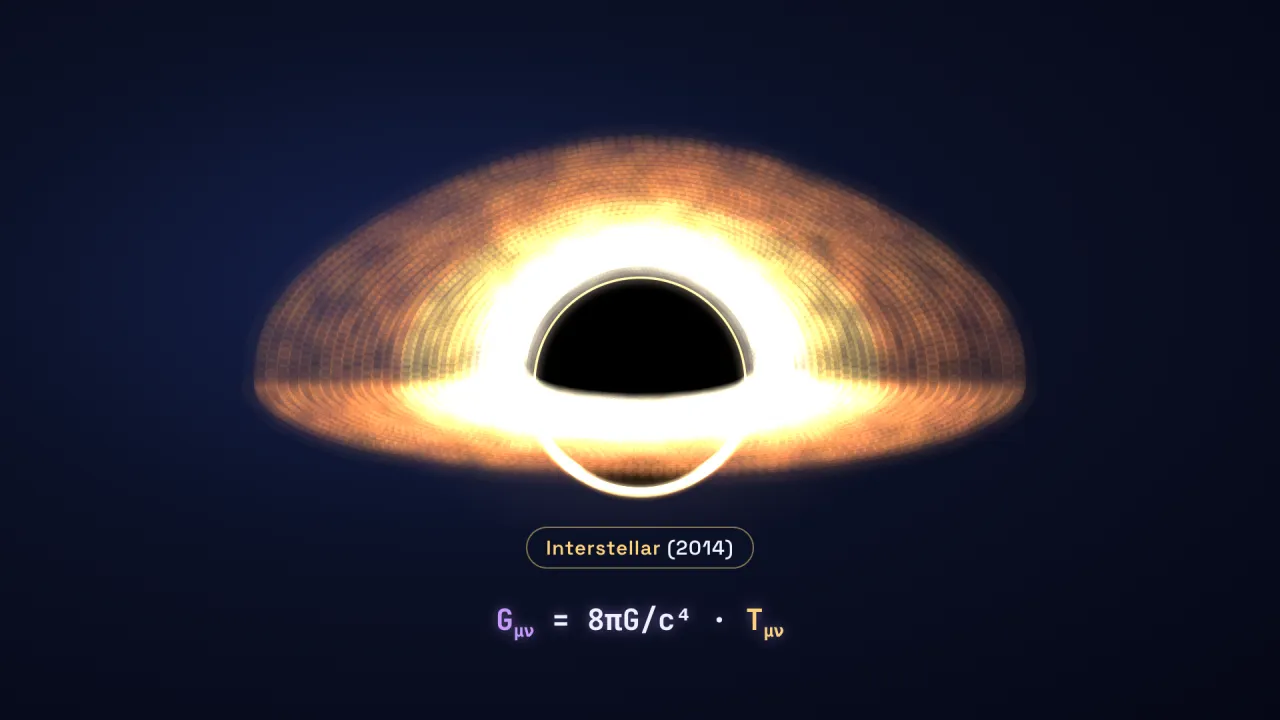
Many black holes are circled by gas slowly spiralling inwards, like water around a plughole. It rubs against itself, heats up to billions of degrees and glows. This disc is what we can see.
Looking at it from the side, you see it in front as a band across the hole. But the light from the far side is bent over and under the hole towards you. So you see the far side above and below at the same time, like a glowing halo. That is exactly how the black hole looks in the film “Interstellar”, because the image was calculated with Einstein’s equations.
One detail is missing from the film: the disc spins at nearly the speed of light, so the side coming towards us shines much brighter. That looked too confusing to the director. But the Frenchman Jean-Pierre Luminet had already calculated it in 1979, on a computer that still needed punch cards. He drew the picture by hand, dot by dot in ink.
And this channel’s logo? If light from a distant galaxy passes exactly behind a heavy mass, it is bent evenly around all sides and reaches us as a perfect ring, an Einstein ring. In 2025 the Euclid space telescope found a particularly beautiful one, just 590 million light years away.
The Bastiverse logo is an Einstein ring: gravity bending light into a circle.
In the video from 3:4504
A telescope as big as the Earth
Black holes are huge but unimaginably far away. Sagittarius A*, the hole at the centre of our Milky Way, is 27,000 light years away and appears in the sky as big as a doughnut on the Moon. To see that, you would need a telescope as big as the Earth.
So astronomers linked up eight radio telescopes: in Hawaii, Arizona, Mexico, Chile, Spain and at the South Pole. Together they are called the Event Horizon Telescope. In April 2017 they all looked at the same hole at the same time for four nights. So that the data could be put together later, each station has an atomic clock. Combined, they are so sharp that you could read a newspaper in New York from a café in Paris.
That produced five million gigabytes, too much for any internet connection. So the hard drives travelled in crates by plane. The drives from the South Pole had to wait half a year, because no planes fly there during the Antarctic winter. Then four teams calculated the image independently of each other. All four found the same ring.
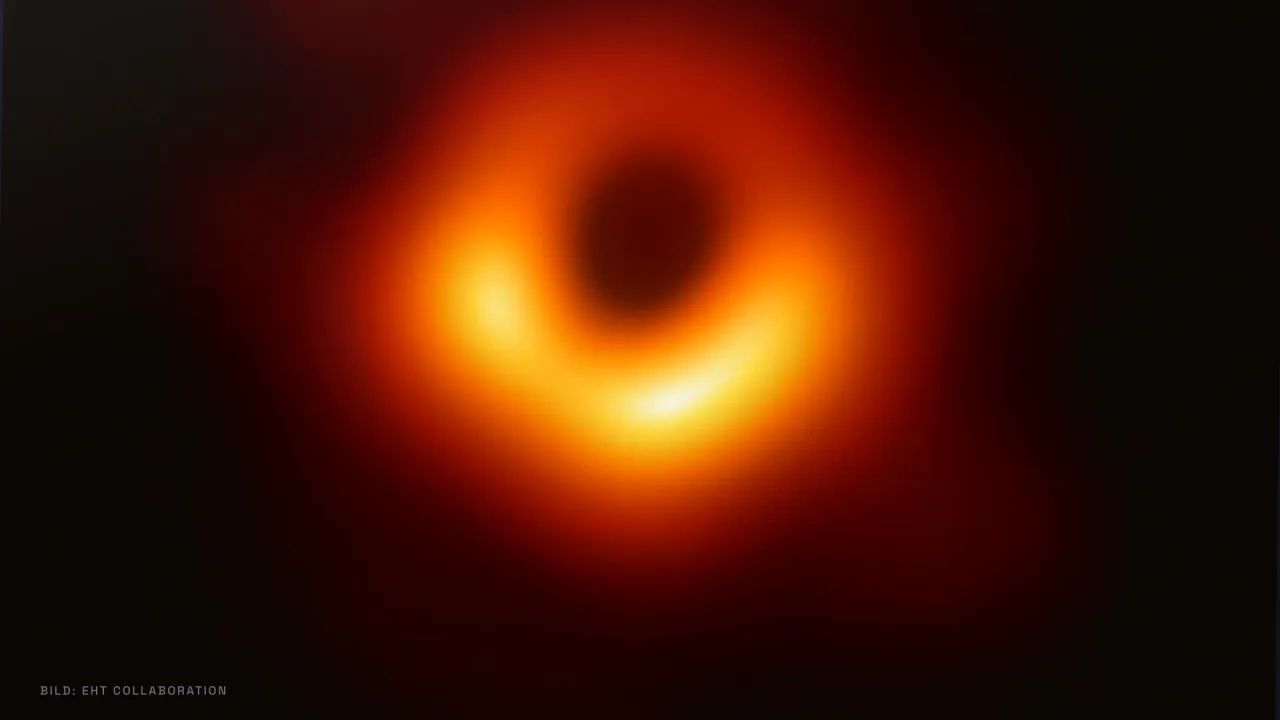
The first photo doesn’t show our own hole but the much bigger one in the galaxy M87, 55 million light years away and as heavy as six and a half billion suns. The dark patch is the shadow, the ring is hot gas whose light is bent around the hole. It is brighter at the bottom because the gas there is moving towards us. In 2022 the image of Sagittarius A* followed, and it looks almost the same.
05
Light from the past
The light in this photo travelled to us for 55 million years. When it set off, the dinosaurs had only just died out. So we don’t see the hole as it is today but as it was back then. How fast light really is, the next episode explains.
Every look into space is a look into the past.
In the video from 7:42
